Why Are We Even Dealing on the Western Expansion?
A 4.6 billion dollar timber company agreed in 2010 to build a new city — roads, parks, a junior Olympic swimming pool, a public beach — free to the community, by contract. The state appropriated 126 million dollars for the same road. Now the city is being asked to sign an agreement that erases every one of those commitments with a single sentence in a recital.
“Westward Expansion” is two development orders, not one. Neoga Lakes — 6,410 acres. Old Brick Township — 5,273 acres. Approved in 2010, side by side, west of U.S. 1. Both required the developer to build the loop road. Both run with the land. The new agreement folds them into a single name and erases the contractual commitments in a single sentence. When you hear “Westward Expansion,” hear both.
The document runs 209 pages. It arrived in March, dated the twenty-third. Four signature blocks at the end. The execution date is blank. The planning board hearing date is blank. Both council hearing dates are blank. The mayor’s line is blank. The clerk’s line is blank.
Blank lines are not nothing.
On the other side of those blanks sit two development orders, signed in 2010, recorded against land that a 4.6 billion dollar timber company owns at the western edge of this city. Inside those orders: a city. Not a subdivision. A city. Roads. Parks. A junior Olympic swimming pool. A public beach at Lake Neoga. Twenty-five acres of community parkland deeded to the city. Thirty acres of neighborhood parks. Forty-five acres of open space. A ten-foot trail system connecting homes to parks to shops. And the roads — roughly 97 million dollars in road construction, the developer’s promise, in writing, to build the infrastructure for the city it intended to sell. That commitment binds every successor and assign. It runs with the land. The people who negotiated it are gone. The people who later tried to set it aside are gone. The land is still there. So is everything they promised.
In our first story in the Westward Expansion storyline, we laid the foundation. The developer agreed to pick up the tab for a new city in 2010 — the road, the parks, the pool, the beach, the trails. Free to the community, by contract. Then the state appropriated 126 million dollars for the same road the developer had already committed to build. And if the city council signs the MPD, the developer walks away from all of it — the road, the parks, the pool, the beach, the trails. Can we claw back what we spent on the road? Don’t know. That’s probably up to the grassroots and those we elect and their willingness to listen.
Here is what the MPD says about all of that.
Deep in its recitals — the whereas clauses — sits one sentence. “The City Council contemporaneously with this MPD and Development Agreement abandoned these prior development orders and they have no further force or effect.” (emphasis ours)
Contemporaneously. Past tense. For an act that has not occurred. The agreement is unsigned. The council has never voted on it. Nothing has happened contemporaneously with anything. The attorneys wrote the obituary before anyone was dead.
There is a detail in the dating worth noting. The agreement is dated March 23, 2026. Its recitals state that a neighborhood meeting “was held on April 22, 2026” — past tense, in a document drafted thirty days before the meeting occurred. The document said it happened. It had not happened.
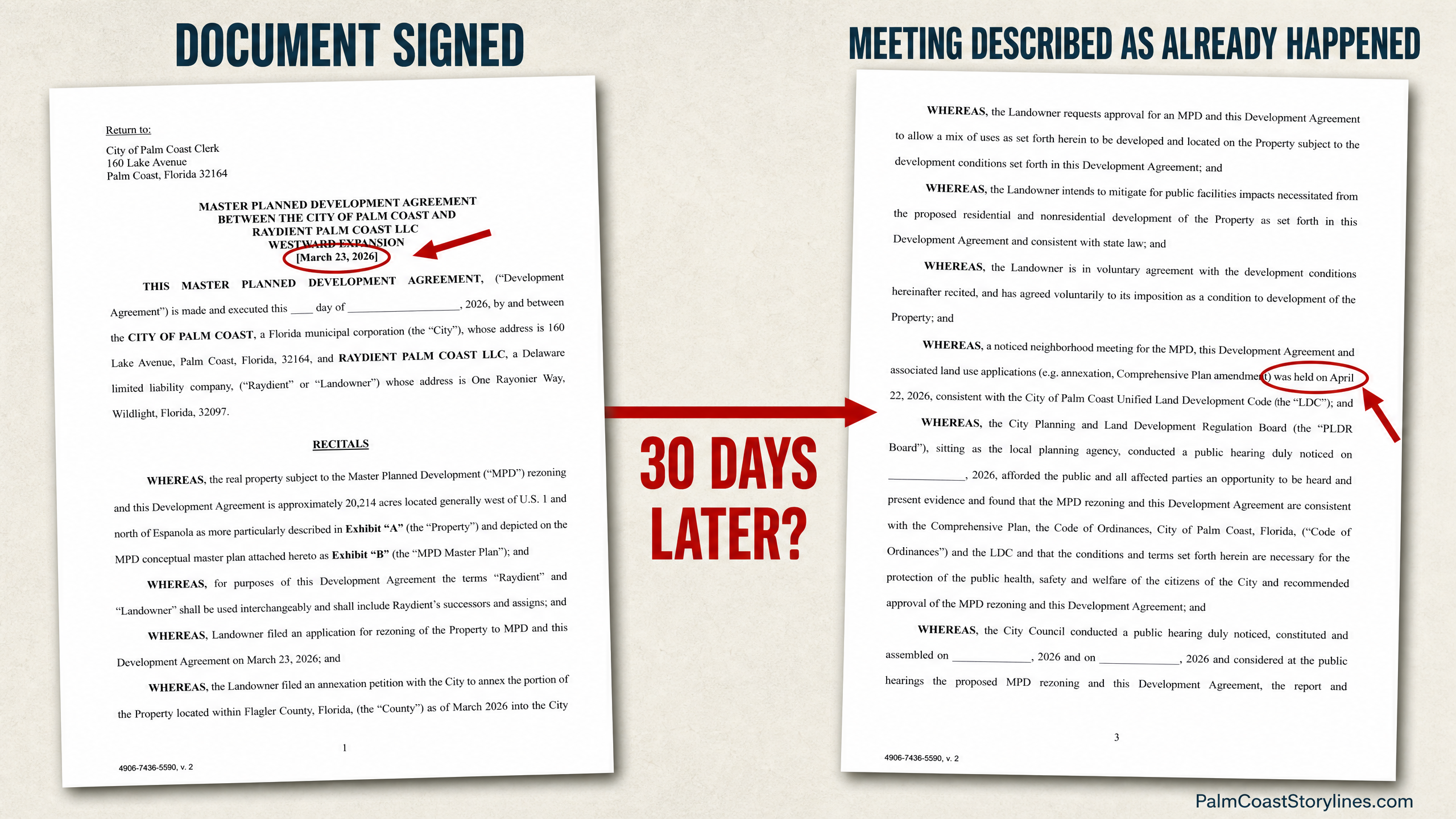
I’m not accusing a multi-billion-dollar corporation of fraud. But if I’d tried to pull something like this with my mortgage, I’d be getting three hots and a cot and making small rocks from big. The meeting did eventually take place. The question is what kind of meeting it was.
Twenty-five people signed in. The mailing list had over 150 addresses. What those twenty-five walked into was an open house — seven storyboard stations, a promotional video rolling on large screens for Raydient communities in other counties. Developer representatives were available if you had a question. Nobody stood up. Nobody explained anything. Nobody wrote down what anyone said.
The reason LDC § 2.05.02(C) exists is not bureaucratic. The city requires the applicant to conduct the meeting, provide information addressing the proposed development, take notes of public comments, and submit those notes before the next step in the approval process — because these are your roads, your parks, your water, your tax dollars, and you are entitled to understand what is being done before anyone signs anything. Information in, comments out, on the record. A transaction the public can verify happened.
The summary on file with the city contains zero public comments. None were submitted, or none were taken. These were your neighbors. They showed up. But nobody conducted a meeting. Nobody laid out what was at stake. And if you don’t know what’s at stake, you don’t know what to ask. As far as the record is concerned, the conversation never happened.
Florida has rules regarding how you can walk away from a tab. Releasing a development order of this kind is a process, and the process has parts. A proposal. A public hearing — noticed, on the abandonment, specifically. A showing of what has been built and what remains owed. And then a notice, recorded with the clerk of the circuit court. The statute’s own words: abandonment “will be deemed to have occurred upon the recording of the notice.”
Not the vote. Not the agreement. The recording.
None of it happened. No proposal. No hearing. No showing. No recorded notice. A public records request went to the city this month asking for the instrument by which the two development orders were abandoned. The city’s response was unambiguous:
“There are no records for the request as the two DRIs have not been abandoned.”
— City Clerk, City of Palm Coast · Public Records Response · June 12, 2026
The recital says the commitments have no further force or effect. The city’s own office says otherwise. Pennyfeather walks the full statutory mechanism in the companion piece running alongside this one. He brings the receipts.
The city’s own people saw the problem before the public did. In April, a packet of staff comments was distributed to the Palm Coast City Council — every reviewing department, in writing. It never reached the public.
The new city was supposed to be free, and now staff was being asked to figure out how to pay for it. This wasn’t a framework they designed. It was handed to them. The financing meant to replace the developer’s contractual commitment — tax increment and impact fees — “may not be adequate” to fund the infrastructure. Meaning we may not be able to afford it. A senior planner went further:
“They don’t want any public hearings at all. No Neighborhood Meeting, they want to operate without involving the public in any way.”
— Senior Planner · City of Palm Coast · Staff Comments on the Westward Expansion MPD · April 2026
The planner wrote that in April. The meeting that eventually took place produced no notes, no comments, nothing the city could act on. The warning came first. The result followed.
The same planner drew the conclusion that two separate city staff members reached independently:
“If this project does not want City staff, City Council, or Residents of Palm Coast know what they are building, perhaps this project is better incorporating as its own jurisdiction and removing us from the process?”
— Senior Planner · City of Palm Coast · Staff Comments on the Westward Expansion MPD · April 2026
The school district wrote in separately, asking whether the new agreement would terminate the developer’s existing school commitments under the DRIs. They didn’t know either. Nobody had told them.
The people doing the technical work now are not the people who designed this deal. They saw the problems. They said so in writing, in a document the public was never shown. Nobody heard them. The question this summer is whether anyone is listening this time.
The pattern broke into public view exactly once. At a council meeting in April, staff presented the loop road to the council — 126 million dollars in appropriations, a contractor gearing up to clear land — framed as a city project, start to finish. No mention of the development orders. No mention of the contractual commitments. Seventy-five minutes later, Vice Mayor Theresa Pontieri responded from the dais.
“The Westward Expansion landowner was supposed to pay for that Loop Road. They are a multi-billion dollar company. And per their development orders, there are two in place for that entire swath of land, per those development orders, they were supposed to pay for that Loop Road.”
— Vice Mayor Theresa Pontieri · Palm Coast City Council · April 14, 2026
Staff did not correct this. Staff did not acknowledge the commitment. The arrangement survived its architects. So did the commitment.
Back in 2024, when the MPD was first introduced, the city’s own planning staff was on record about the status of the orders. “That does not make the DRI go away… you still have the DRI and they still have the entitlements.” In plain terms: the developer was still contractually obligated to build — and the city still had the right to hold them to it. The orders were in force then. They are in force now. Nothing in between changed that.
On May 14, Pierre Tristam of FlaglerLive covered the loop road groundbreaking. The mayor stepped to the podium and set the ceremony aside. “Do you want me to be diplomatic or be Mike Norris?” Then: “I don’t support this project. And I’m going to fight it all the way.” By his own accounting — his figures, from the podium at the city’s own event — 226 million dollars lobbied from the state while residents stand exposed to 330 million dollars in infrastructure costs. “That’s not the way you do business.”
Vice Mayor Theresa Pontieri didn’t attend. Asked about it afterward: “I think my absence can speak for itself.”
Three weeks later, the developer answered on the radio. Mike Hahaj, Raydient’s director of commercial development and operations, speaking on WNZF on June 5: “What was contemplated in those DRs, or DRIs [developments of regional impact], are really at the local level kind of thing, and you know, frankly, the infrastructure and that groundbreaking we had the other day isn’t even on land that was associated with those. That’s an entirely different piece of property, so a little bit of a mismatch there, I think, when you try to compare the two.”
The Old Brick Township development order assigns the developer construction of the Matanzas Woods Parkway Extension — every segment crossing its property, railroad overpass included. The Matanzas Woods Parkway Extension is the loop road. The segments are the same road. The record doesn’t think. The record states.
Pontieri put the structural point on the record after the broadcast:
“We cannot allow the internalization of profits and the externalization of costs by the developer.”
— Vice Mayor Theresa Pontieri · City of Palm Coast · [DATE TBD — confirm from record]
The city is building the road anyway. A hundred and twenty-six million dollars of public money, moving now, on a road the developer committed sixteen years ago to build. Spent before anyone asked the developer for a dollar.
The agreement is unsigned. The development orders are in force. The city manager, who inherited this file along with everyone else in the building, postponed the review in May — two weeks before the planning board was set to hear it. His reason, on the record:
“I want to worry about being right.”
— City Manager Mike McGlothlin · From: Palm Coast City Manager McGlothlin Postpones Raydient Development Review as It Needs ‘More Work’ · FlaglerLive · May 8, 2026
He set himself a window to early July. In November, three of five council seats turn over.
That is the squeeze. A deadline, a turnover, an unsigned agreement, and the pressure to close with the council currently seated. But the squeeze only works if the council believes it has to sign. This council did not build this arrangement. The framework was handed down from people who no longer work there, on behalf of a company that never delivered on what those same people agreed to. Inheriting a problem is not the same as inheriting a duty to resolve it on someone else’s terms.
The development orders are on the land. The process is on the books. The leverage is at the dais.
So the question is simple. Why are they even dealing?
Master Planned Development Agreement between the City of Palm Coast and Raydient Palm Coast LLC. Filed March 23, 2026. Not yet executed — signature lines blank. Covers approximately 20,214 acres west of U.S. 1. Key recital: the City Council, contemporaneously with approving this MPD, abandoned both the Old Brick Township DRI and the Neoga Lakes DRI — declared them of no further force or effect. Those DRIs required the developer to build the Palm Coast Parkway Extension and Matanzas Woods Parkway Extension — contractual commitments worth approximately $178 million in 2010 dollars. The MPD replaces those enforceable commitments with a road dedication framework funded primarily through impact fees and tax increment financing. Raydient is authorized for 22,000 homes. The original DRIs authorized 12,000. Obtained via Chapter 119 open records request.
City of Palm Coast staff comments on the Raydient MPD Agreement. Eight city departments independently flagging major concerns: infrastructure funding via proportionate share likely insufficient; only entry and exit for the first two phases is Matanzas Woods Parkway; nothing in the MPD addresses existing infrastructure impacts; no school mitigation agreement; agreement language implies the MPD supersedes the Charter, the Comprehensive Plan, and the Code of Ordinances. One Senior Planner wrote: “if this project does not want City staff, City Council, or Residents of Palm Coast know what they are building, perhaps this project is better incorporating as its own jurisdiction.” Utility agreement absent. Package treatment plants permitted. No future public hearings required after MPD approval. Obtained via Chapter 119 open records request.
Neoga Lakes Development of Regional Impact Development Order. Effective October 5, 2010. City Resolution 2010-138. Approximately 6,410 acres west of U.S. 1. Special Condition 25 establishes the developer’s transportation mitigation: proportionate share $73,355,792 (2010 dollars). The Palm Coast Parkway Extension — the loop road — is an unconditional contractual commitment triggered at 1,400 p.m. peak hour trips: developer shall cause the road to be constructed and dedicated to the City. Default enforcement: building permits stop. Commitments run with the land and bind all successors and assigns. Special Condition 29 requires construction of a public park of up to 29 upland acres including a junior Olympic swimming pool and conveyance of up to 4 acres at Lake Neoga for a public beach. None of the above built. No land conveyed. Obtained via Chapter 119 open records request.
Old Brick Township Development of Regional Impact Development Order, with Settlement Amendment (Resolution 2011-56). Effective September 7, 2010. City Resolution 2010-114, as amended by Resolution 2011-56 (June 21, 2011). Approximately 5,273 acres northwest quadrant, west of FEC Railroad. Specific Condition 29 establishes developer transportation commitments: proportionate share $24,202,922 (2010 dollars). Developer is obligated to construct the Matanzas Woods Parkway Extension — the loop road — including the FEC Railroad overpass, prior to the first City building permit for any vertical construction. General Condition 19(e): the development order “shall operate as a perpetual burden and servitude upon the DRI Property unless released by the City by means of an appropriate recordable instrument approved and executed by the City.” No such instrument has been recorded. Obtained via Chapter 119 open records request.
Nobody asked her to read it. Nobody flagged it. She read it because that is what she does — when something comes before the council, she reads the source document, not the summary.
What she found: a private corporation had agreed in writing to build $109 million in roads as a condition of their development rights. The contractual commitment ran with the land. It had teeth. Nobody enforced it. Nobody mentioned it.
By the time Vice Mayor Theresa Pontieri sat down with that document, $105 million in Florida tax dollars had already paid for what a private multi-billion dollar company was legally required to build.
She brought it to the dais on September 3, 2024. On the record. In public. This is that moment.
Somebody filled out a form in Tallahassee. It is called a Local Funding Initiative Request — a LFIR. This one is for Phase 3 of the loop road. Filed January 4, 2024. Senate sponsor: Travis Hutson. The ask: funds for right-of-way acquisition, design, permitting, and construction of a multi-lane road extending Palm Coast Parkway over the Florida East Coast Railway — opening 20,000 acres of land that a private corporation had a contractual commitment to serve. The form is public record. It is in this library.
Further reading For more on how LFIRs work, read R. Whitmore Gaines, Esq. (Ret.)’s explainer →Remember Priority 1? Power restoration for thirty thousand Palm Coast residents on PEP tanks — the people who lose their systems in a storm. The council voted it their top legislative priority on August 17, 2021. The first LFIR ever filed for that project was filed on March 6, 2025. Three years, six months, and seventeen days later. By that time, the loop road — Priority 3 — had already pulled in $25 million in FY2023-24 and $80 million in FY2024-25. Priority 1 had pulled in zero. This is the form. It is also in this library.
Palm Coast Unified Land Development Code § 2.05.02(C) — Neighborhood Meeting Criteria. The applicant shall conduct the meeting and provide necessary information and materials to attendees that address the proposed development. The applicant shall provide a sign-in sheet and take notes of public comments. A copy of the sign-in sheet and comments shall be provided to the City prior to the next step in the approval process. This is the controlling requirement for neighborhood meetings in connection with Master Planned Development applications in Palm Coast, as amended by Ordinance 2024-17, November 12, 2024.