If we’re out of water, why are we approving new developments?
The city has told a developer, a camera, and a court that there isn’t enough water. So why do the approvals keep coming?
We asked them.
The city’s most powerful attorney since its inception walked to the podium to weigh in on an annexation the council was about to pass.
That is not something an attorney of his stature does. They don’t have to. They pick up the phone.
His name is Kent Saffert. He was there for Palm Coast Holdings and Florida Landmark — the companies that own Town Center, the fifteen-hundred-acre downtown this city has spent twenty years building itself around. The most powerful landholding interest Palm Coast has had since the day it was chartered. Saffert is their attorney. When he speaks into a council microphone, he is not speaking for himself, and every man on that dais knows it.
He was not there to comment generally. He was there because the council was about to vote on the Flagler Pines annexation — nearly forty acres out on State Road 100 — and the ordinance before them contained a specific representation he intended to challenge. He came armed with the document. He read the clause out loud. And then he told the council it was getting sued.
His company was contracted to sell property within the DRI — land carrying vested rights to develop, supposedly including sewer rights. The buyer did what buyers do. He went to the city to run his due diligence — to confirm the water and the sewer were there before he closed. The city told him they were not. There was not enough capacity. The buyer walked. The deal was dead.
He laid it out plainly:
“We spent over $35.5 million in infrastructure improvements. Roads, sewer, water, donating the property to the city in exchange for vested rights — vested rights to develop the 1,500 acres within the DRI. We’ve spent that money. We cannot develop that property now because there is no sewer or water capacity in that.”
He told them why the deal collapsed:
“Those buyers backed out of the deal after they met with the city and the city said you don’t have guaranteed rights or sewer and water capacity. You don’t have it, so they left the deal.”
Then he put his finger on the document the council was about to pass. An annexation — nearly forty acres out on State Road 100, commercial ground, the kind of parcel a big-box store ends up sitting on. The fourth clause of that ordinance says the city is in a position to provide municipal services to the land.
“I don’t think that’s an accurate statement. Can you provide municipal services to properties within the city already? You certainly can’t provide it to properties outside the city.”
The council heard every word of it.
Then it voted to approve the annexation. Unanimous. Same night. Same room. The ordinance it passed still carried the sentence Saffert had just told them was false.
One meeting. Both ends of the contradiction.
We laid all of it out in the first story of this series: Why Are Our Water Bills So High? And you have heard the city say it in its own room. At a March 4, 2025 council meeting, the mayor put the question to Jason DeLorenzo, then the city’s chief of staff, in plain words: could the system carry the nineteen thousand units already approved and waiting? The answer came back in two words. No, sir.
That is settled. That is the city’s own record.
So here is the only question left worth asking. If there is no water, why do the papers saying there is keep getting signed?
The biggest one is moving right now, and it is not even in front of the city. It is in front of the county.
Off Seminole Woods Boulevard sits a little over a hundred acres of open ground. The plan for it is about five hundred homes — single-family, townhomes, apartments — plus a shopping center and an assisted-living facility. It belongs, up the chain, to Mori Hosseini’s ICI Homes, one of the largest builders in the state. The planning board waved it through earlier this year, six to nothing, not one resident speaking for it and a roomful speaking against. The county commission moved it forward this month.
And here is the catch that should hold your attention. It will drink Palm Coast water and flush into Palm Coast sewer — the same strained system, the same full plant — but because of an old settlement between the city, the county, and Flagler Beach, it does not have to annex into the city to get the service. Palm Coast carries the load. Palm Coast gets no say. The county votes. You pay.
The attorney who brought it is a name you are going to keep seeing. Michael Chiumento. He was in the room back in 2003, when the original Town Center order went on the record. He has been the lawyer for that ground — and for the capacity question riding underneath it — for the better part of a quarter century.
Standing before the county planning board, he told them the water was handled:
“The city utility department reviewed the application and the PUD and determined that there was sufficient capacity in their plant to serve it, so we don’t have any issues of water, sewer or reuse in the area.”
He pointed the commissioners to a letter from the city saying the service was available — and in the same breath allowed that any actual building would still have to clear concurrency before a shovel went in the ground. Available — until the moment it isn’t.
It is not a new pattern. Two years before that, City Manager Denise Bevan signed a modification to the Town Center order — on the basis of a letter from Chiumento’s own office. Not the utility department. The developer’s attorney.
And the developer behind the American Village apartments warranted to its lender that all required utilities were available. That warranty is dated before DeLorenzo said “No, sir” on camera at a city council meeting.
The papers keep saying one thing. The record keeps saying another.
They built the pipes. They spent thirty-five million laying the bones of Town Center — the roads, the water lines, the sewer. They hold a signed order promising them service. And when their buyers came and asked for a guarantee, the city said no.
Yet others are getting the nod.
The people who built the pipes got told no.
It has told us there is no water — to a developer, to a camera, to a court. We believe it. The record is its own.
So this is not a story about whether the water is there. That part is settled.
There is one more paper, on file since 2003. The original Town Center order carries two separate prohibitions — one for water, one for sewer — and the 2024 amendment carried both forward verbatim: no building permit shall issue for any subsequent phase until sufficient capacity exists to meet the city’s adopted level of service. The city wrote those conditions in. The city has lived under them for more than twenty years.
Then the city did something. In January 2024, it signed that new version of the order — the one that vested the developer for water and sewer concurrency. In the same instrument, it deleted the one requirement that made someone check — the periodic, mandatory analysis confirming that capacity still existed before more development went forward. The gate is still written into the order. The alarm is not.
Meanwhile, the permitting process continues. Records show multiple active applications to build inside Town Center — at least three involving dredging or filling wetlands. One of them belongs to Jeff Douglas, the developer’s own authorized agent named in the DRI order, who has been waiting on a wetlands permit for land on Seminole Woods Boulevard since May 2023.
Then, in its motion to dismiss the Town Center lawsuit, the city argued the opposite — that there is no contractual commitment to physical capacity at all.
Both cannot be true. A judge will sort it out this November.
It is a story about a city that has the answer in its own files and keeps signing the papers anyway.
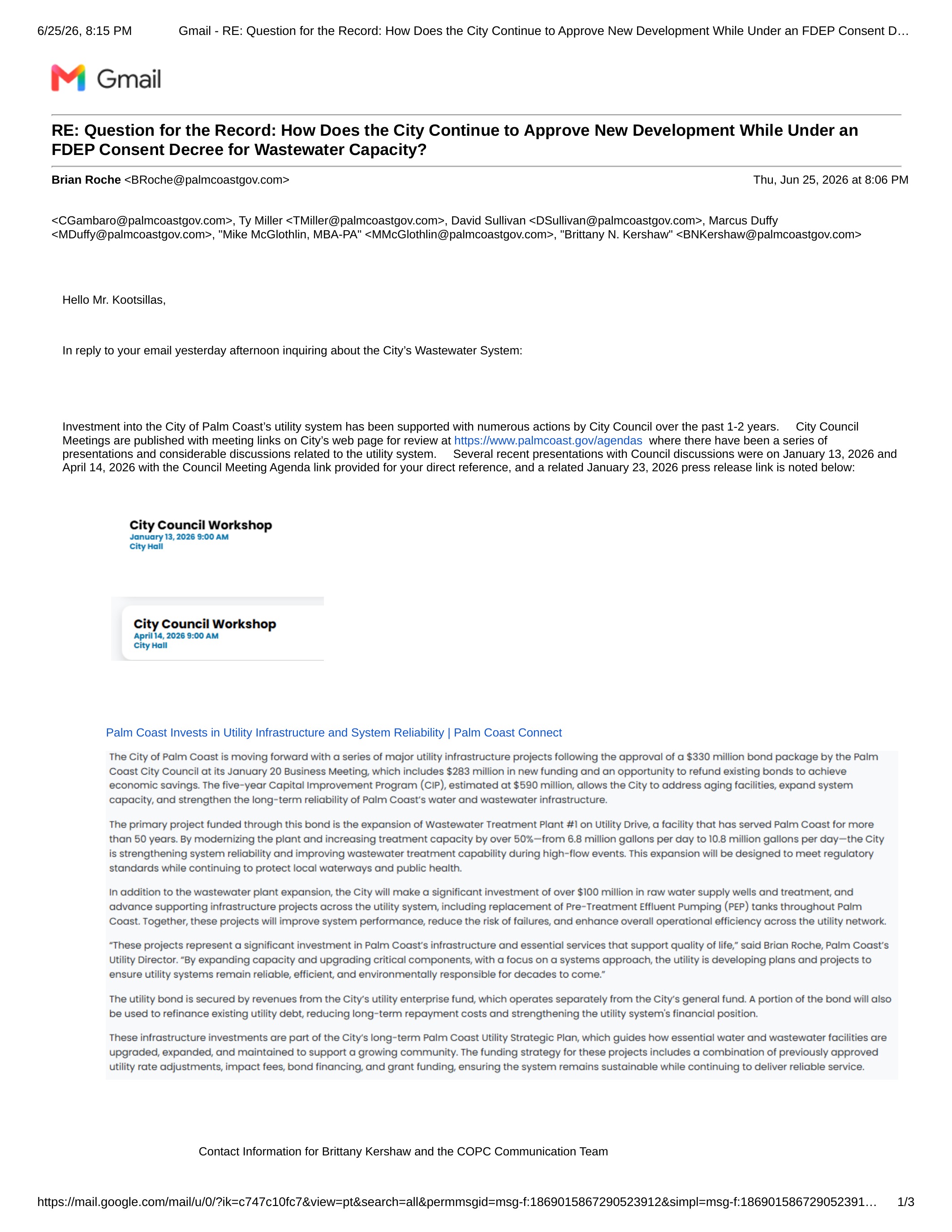
So we asked the city.
If there is no water, why do we keep approving new developments?
And they answered:
Town Center at Palm Coast Development of Regional Impact Development Order — the original, 2003. The founding development order every later modification hangs off, and the document the contradiction in this story turns on. Recorded at OR Book 959, Page 1509. Obtained via open-records response.
Ordinance 2003-32 and the PUD Development Agreement. Instrument 2003071128, OR Book 1025 Page 1405, recorded December 30, 2003; adopted December 16, 2003 under Mayor James V. Canfield. The founding zoning document — its utility obligations flow from the DRI Development Order.
Resolution 2008-89, a three-year extension of the Town Center DRI. Instrument 2008017111, OR Book 1664 Page 1882, recorded June 4, 2008; adopted May 20, 2008 under Mayor Jon Netts. Its Whereas clause locates the original Development Order at OR Book 959 Page 1509 — the provenance trail to the founding paper.
Town Center DRI minor modification — Crest Town Center. City Manager Denise Bevan alone: no council vote, no planning board, no public notice. Converts 205,000 sq ft of commercial to 250 residential units. The Chiumento letter of April 28, 2022 is the sole utility basis, with no independent utility-department analysis. OR Book 2686 Page 1790, Instrument 2022024875, May 2, 2022.
Second Amended and Restated Town Center DRI Development Order — the current operative order. Effective February 6, 2024, recorded June 5, 2024.
The developer behind American Village borrowed more than four million dollars against the project. To get the money, it had to make promises to its lender. One of those promises — sworn to in the mortgage itself — is that all the utilities the project needs, including water and sewer, are available.
January 22, 2026 — three weeks before the Flagler County Planning Board hearing on the Seminole Woods Mixed Use PUD — Palm Coast Planning Manager Phong Nguyen submitted the city’s formal written review to Flagler County Growth Management Director Adam Mengel. The overarching concern, Nguyen wrote, was the availability of water supplies, public facilities, and services. Potable water and sanitary sewer were proposed to be provided by the City of Palm Coast. And the applicant, Nguyen wrote, still needed to secure commitments from the city for reservation of capacity. No commitments had been made. Then, on February 10, 2026, attorney Michael Chiumento told the planning board the city had reviewed the application, determined sufficient capacity existed, and that he had a letter confirming service was available. We have the January 22 document. We have asked the city for the letter. It has yet to be produced.
March 4, 2025 City Council Business Meeting. Mayor Norris asks Jason DeLorenzo, then the city’s chief of staff, whether the system can carry the 19,000 housing units already permitted and in the pipeline. The answer: No, sir.
August 12, 2025 City Council Workshop. City utility staff presents the capacity figures to the full council on camera. 13,381 units in the pipeline assigned to Plant 1 require 2.4 million gallons per day of additional capacity. Vice Mayor Pontieri asks how many units the plant can currently support. Staff cannot answer. Later in the same meeting, staff clarifies: the city does not reserve capacity in the utility system.
Observer Local News, February 11, 2025, reporting the FDEP consent decree — issued July 29, 2024 — ordering expansion of Wastewater Treatment Plant 1 by 2028.
Florida Department of Environmental Protection permit application database, Northeast District, Flagler County — State 404 Individual Permits under review as of June 25, 2026. Multiple active applications inside Town Center at Palm Coast, including Application 0419238-002-SFI (Douglas Property & Development / Seminole Woods Blvd, filed May 2023) and two separate Town Center applications filed in February and March 2024. All currently under review.
Every document named in this story lives in the Evidence Locker — read it yourself, hash and all.