Alleged procedural defect in 2011 election that moved city elections from odd to even years — speaker argued the ballot question was placed on a primary rather than a general election in violation of Florida Statute 166.031, rendering subsequent elections and charter amendments (including 2018 and 2019 changes and a 2022 council pay raise) unlawful.
Speaker also raised concerns about rising qualifying fees for candidates.
Speaker noted an upcoming meeting with a developer regarding an affordable housing project he had previously raised.
Speaker also asked about the lack of a road connection between East Hampton Boulevard and US-100, citing traffic congestion, single-point-of-access concerns, and informal encampments in the wooded gap area, and asked council to consider the issue.
Speaker announced he is leaving Palm Coast after selling his home to a young couple.
He reflected on four to five years of civic participation and encouraged residents to engage with local government through planning boards, town halls, and public meetings rather than passively complaining, characterizing citizen participation as powerful and consequential.
Speaker raised the legal concept of nuisance as it applies to development-related flooding, arguing that a property that functioned without flooding for years and then experienced recurring flooding after adjacent development should prompt the city to examine what changed and whether its approval process adequately protects neighboring property owners.
Speaker asked what analysis the city performs to ensure development will not adversely impact adjacent properties, and stated residents deserve to see or know about such documentation.
Flagler County Commissioner Kim Carney and community paramedic Rob Barrett presented the File of Life initiative, a reinvention of the 1980s Vial of Life program.
The packet — a magnetic envelope for the refrigerator containing a health profile, emergency contacts, medications, and DNR form — is free and hand-delivered by county paramedics.
Commissioner Carney shared a personal story about her mother's end-of-life experience to illustrate the importance of having the correct yellow Florida Department of Health DNR form on hand.
Council expressed support and the mayor asked staff to promote the program on social media and the city website.
Finance staff (Gwen Ragsdale, Railene Bowman, Helina Albs) presented an overview of the TRIM process and property tax history.
Preliminary FY2027 taxable values show a 3.58% overall increase but a 1.25% decrease for existing properties, with new construction accounting for 4.83%.
At the current millage rate of 4.0893, the city would collect approximately $44.7 million.
Staff noted FY2027 budget development will be especially challenging.
Council discussed the potential fiscal impact of the statewide homestead exemption amendment, the city's heavy reliance on residential ad valorem revenue (90/10 residential vs. commercial), and Vice Mayor Pontieri requested specific financial documents including Holland Park settlement fund breakdown, appropriated fund balance detail, and reserve analysis.
Mayor Norris described working on an austerity budget resolution with the city attorney, and council reached consensus to have a draft circulated.
Planning Manager Fong Wynn presented proposed amendments to LDC Chapter 2 covering review authority, enforcement, and procedures.
Key changes include: clarifying neighborhood meeting standards (standardized notice, audio-visual requirements, online attendance option, two required meetings); updating public hearing notice requirements; revising development order review procedures per Senate Bill 1080; clarifying special exception process for prohibited uses requiring supermajority vote; and updating plat and unbinding lot provisions.
Council directed multiple changes: requiring all residents in an HOA within notice radius to receive individual notice; clarifying waiver conditions for neighborhood meetings; reducing development order extensions from three 12-month periods to one; extending the re-application waiting period after denial from 12 to 24 months; changing MPD infrastructure bonds from 'may' to 'shall unless waived by council'; and requiring annual public notice of the designated Land Use Administrator.
Community Development staff Michael Hansen presented proposed amendments to LDC Chapter 3 covering zoning, uses, and dimensional standards.
Major changes include: adding data centers as a prohibited use (requiring supermajority council vote, limited to IND1/IND2 if approved, subject to industrial performance standards); codifying fuel depot prohibitions; expanding use tables for MPDs; codifying short-term rentals; adding vertiports for VTOL/eVTOL aircraft in non-residential zones; adding quick-lube/tire shops as a permitted use; changing tattoo/body-piercing studios from special exception to permitted use in COM2; and updating floor area ratios consistent with the comprehensive plan.
Council directed staff to add mandatory conditions for any approved data center (closed-loop system, self-contained energy infrastructure, sound attenuation), to clarify that view protection zones in existing golf course communities shall be maintained upon redevelopment, and to review residential density bonuses near the airport.
Staff continued with Chapter 4 amendments covering conditions for specific uses and activities.
Key proposed changes include: expanded accessory structure standards; allowing mechanical equipment in front yards with screening if rear/side placement is infeasible; limiting accessory structures to 50% of living area (with exceptions for agricultural zoning); extending allowable garage length from 30 to 40 feet and allowing up to 20-foot height to accommodate recreational vehicles and boats; codifying boat-house roof material flexibility; treating gazebos and pergolas the same as sheds; adding playset height and siting standards; updating home occupation language consistent with state statute; codifying recreational vehicle park amenity allowances; and updating the Live Local Act section to reflect House Bill 1389 changes effective July 1.
Council directed staff to remove the land use administrator's subjective authority to approve taller fences and route variance requests to PLDRB, and to bring back a proposal for mandatory seawalls on vacant saltwater canal lots along with a count of such lots.
Landscape architect Richard Picatachi and environmental planner Dylan Rodriguez presented Chapter 11 amendments on tree protection, landscaping, buffers, and irrigation.
Changes include: requiring native and drought-tolerant vegetation; clarifying buffer width adjustments; updating tree replacement ratios and pine tree credits; establishing foundation planting requirements; requiring smart/moisture-sensing irrigation; requiring certified arborists for certain activities; and requiring as-built landscape drawings before certificate of occupancy.
Council directed staff to research financial penalties comparable to St.
John's County's $35,000-per-acre fine for unauthorized clearing, to add buffer requirements where the table currently shows 'none' between commercial/industrial and single-family uses, and to look into further legal protections for the hard canopy corridors east of I-95 and along Palm Harbor Parkway.
Planning Manager Fong Wynn presented Chapter 14 (Glossary) amendments, which included removing earth tones from the prohibited colors definition, revising the single-family dwelling definition to specify one range/kitchen, removing minimum breezeway length from the attached garage definition, defining 'range' as a combined cooktop and oven appliance, updating sign definitions to add 'digital sign,' and adding a data center definition (updated that morning to include cable landing stations as a similar use).
Council directed staff to also define data center subtypes/tiers (e.g., hyperscale) and bring those definitions back at the July LDC wrap-up.
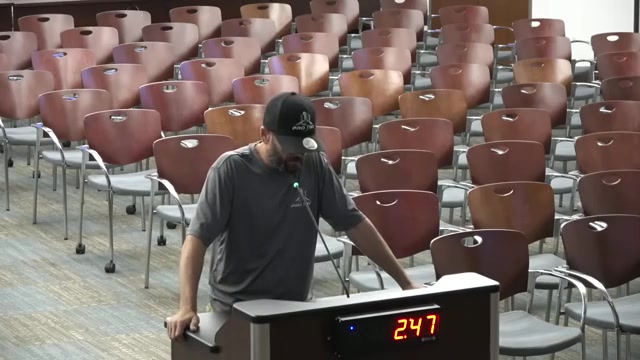
Speaker thanked council and staff for the day's workshop and acknowledged progress in agenda transparency.
He drew a distinction between litigation as a remedy and the government's obligation to proactively explain how development approval decisions are made — including what standards were applied, what analysis was performed, and what evidence supported conclusions — arguing that residents should not have to sue simply to understand a government decision affecting their property.