Palm Coast
storylines...

Independent Reporting · Palm Coast, Florida
From the Publisher

Although the author of this piece laughingly swats the study aside, we did a thorough analysis with all the numbers (to the penny) and all the math to justify doing so. Read our analysis and here.

Westward Expansion Investigation  ·  Prelude

Westward Expansion:
The Study? Give Me a Break.


The paperwork that started this was signed in 2010. , a couple months apart, back when the land west of U.S. 1 was still pine and pulpwood and nobody in town could have told you what a Neoga was.

Next Tuesday, it gets decided.

Annexations. The land use map. . First reading, all of it, one agenda. Sixteen years of paper, and the clock on it now runs in days.

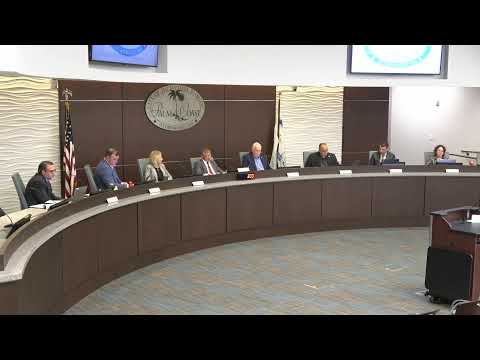
Last week, from the dais, Councilman Charles Gambaro made the case for it. He talked for four minutes. Eight million square feet of commercial space, he said. Construction jobs in the tens of thousands. Amendment 3, and a tax base still running over ninety percent residential.

Eight million square feet sounds enormous until you drive down 95 into Daytona and look at what’s already standing there. The distribution centers along that corridor run about a million square feet apiece.

The Study? Give Me a Break. 1:17
Councilman Charles Gambaro — Palm Coast City Council special budget workshop, July 28, 2026.

Eight million square feet is not a lot.

He wasn’t wrong that this town needs a broader tax base. He was just late, and looking the wrong direction.

Because we had one coming. The council that ran this place before this one spent its time doing the opposite — taking what could have been commercial and turning it residential, rooftop after rooftop, and then crowing about how low they’d kept the taxes.

Alfin. Danko. Klufas.

They kept them low the way you turn the radio up when the car starts making a noise that sounds expensive.

The water and sewer systems were falling behind the whole time, and they knew, because the study they commissioned told them so. What happened to the department head who raised the alarm about it after that study came back? He was demoted.

So here we are, paying more now than we ever would have paid then, because infrastructure doesn’t wait politely while a council decides it would rather not be the one to raise a rate.

In four minutes, Gambaro did not say the word water.

He did not say sewer. He did not say capacity. He did not say treatment plant. Not once, in the whole pitch, on the one question that has driven every hard vote taken in that room since this council was seated.

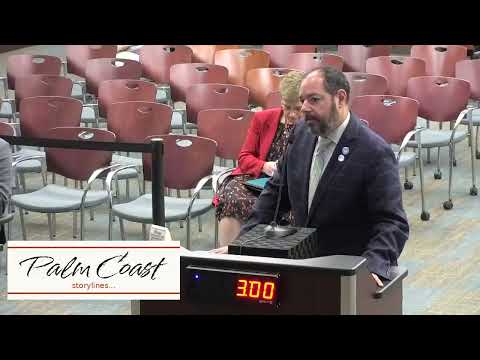
That question already has an answer on the record. In March of last year, Mayor Norris pulled staff to the podium at a special workshop and asked whether the system could handle the nineteen thousand homes already approved and waiting.

Oh, no, sir.

Even with both bonds?

No, sir.
19,000 homes, two answers 0:40
Palm Coast city staff, responding to Mayor Mike Norris — special workshop, March 7, 2025.

Nineteen thousand was just the city. Norris didn’t stop there. A week or so ago, he asked staff for the county’s number too: the homes already queued up out there that Palm Coast will be obligated to serve. That figure stacks on top of the nineteen thousand. Neither number includes a single house in this deal.

Few noticed it.

One wonders what that number is.

The study Gambaro was waving around says the whole thing pays for itself and then some. It’s laughable, because it assumes impact fees will cover the way, and that water and sewer are one quick and easy connect away. Charles Pennyfeather went through it line by line and has the full accounting. Read it. Then read the study itself — we published that too, so you don’t have to take anybody’s word for it, including ours.

Which brings us back to that same meeting, and one last thing.

When the county’s attorney and the school board’s attorney showed up at the planning board to say what this project would cost the people they work for — four thousand four hundred students, a seventy-seven million dollar hole after impact fees — a lot of this town stood up and cheered. Somebody finally came and did the arithmetic out loud.

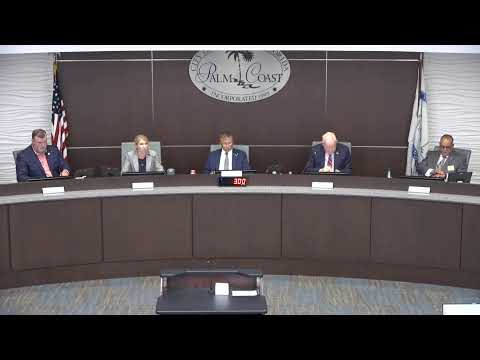
Gambaro’s response, six days later, was that the man was “freelancing.” That he didn’t have authorization to be in the room. That it was “unprofessional and unacceptable,” and he wasn’t sure what the attorney’s “personal agenda” was.

He looked forward, he said, to addressing it face to face.

Where I come from, those are fighting words. Anywhere, they’re totally inappropriate.
The Study? Give Me a Break. 1:23
Councilman Charles Gambaro — Palm Coast City Council, July 21, 2026.

Six days.

Sixteen years of contractual commitments, two development orders, a hundred million dollars of road that somebody promised to build and somebody else is now going to pay for — and it comes down to a first reading on a Tuesday night in August, in a room that holds maybe two hundred people.

Stay tuned for our four-part series leading up to the vote.

Westward Expansion:

….The Origin Story

….DRI / MPD: What’s the Diff?

….Anomalies and Oddities

….Scoring the Vote from the Record

We’ll be there. Bring a chair.

— Johnny Diamond  ·  PalmCoastStorylines.com

The Two DRIs

Both Developments of Regional Impact, approved under Section 380.06, Florida Statutes, in 2010 — the two that began transitioning to a single MPD at this meeting.


PDFOld Brick Township (OBT) DRI

Development Order dated September 7, 2010, following public hearings August 17 and September 7, 2010. Original Application for Development Approval filed May 27, 2008.

  • 39 numbered General and Specific Conditions; 17 stand as their own enforceable requirements — water supply, groundwater protection, wastewater, stormwater, water quality monitoring, solid waste, transportation, air quality, low-impact development, police and fire protection, recreation and open space, education, workforce housing, historical and archaeological sites, silviculture, the community development district, and firewise protection.
  • Specific Condition 29: total transportation improvement value of $68,928,160, developer’s proportionate share $24,202,922.
  • School mitigation: $25,155,556 (2010 dollars) for an estimated 1,085 students, satisfied via a donated school site plus impact fees.
  • Workforce housing: at least 5% of every non-age-restricted unit, 15-year deed restriction.

PDFNeoga Lakes DRI

Development Order effective early October 2010 (best-supported date: October 5, 2010, the date of the final approving City Council hearing). Planning Board hearings August 18 and September 15, 2010; City Council hearings September 21 and October 5, 2010.

  • Special Condition 25: total transportation improvement value of $109,782,519, developer’s proportionate share $73,355,792.
  • Workforce housing: 350-unit minimum tied to specific building-permit triggers, 20-year deed restriction naming the City as enforcer.
  • Special Condition 29(a): a public park of up to 29 upland acres, including a junior Olympic swimming pool, changing rooms and restrooms, a playground and play field(s) — deeded to the City within two years of the first residential building permit.
  • Special Condition 29(b): a separate, up-to-4-acre “Public Beach” at Lake Neoga for public swimming — though this one had an escape hatch: if the developer and City didn’t reach an operational agreement before the first certificate of occupancy in Phase II, the developer was released from ever conveying it.
  • An extensive 10-foot-wide, paved “Pathway System” for bicycles, golf carts, low-speed vehicles, and pedestrians, running along every arterial and collector road and out to U.S. 1 — explicitly designed as “an alternative to the automobile.”
  • Land use plan built around one defined “Village Center” (up to 274,000 sq ft commercial, 475 multi-family units, 75 single-family units, 45,000 sq ft office, 150 life care units), a separate Neighborhood Retail area, and a 1.87 million sq ft Employment Center — with the Pathway System explicitly meant to “connect the neighborhoods with the Village Center, workplace.”

Combined, the two DRIs put roughly $97.5 million of road funding on the developer’s own books — and 85 acres of parks and open space, at buildout, across the combined footprint.


Note: these aren’t copies of the documents you get from the City. Those are useless — just old paperwork shoved through now-obsolete scanners. You can’t do anything with them. They’re just pictures. We ran these through our PDF Fixer so you can search them, and copy and paste from them.

The MPD

The document that replaces both DRIs — a statutory Development Agreement under Sections 163.3220–163.3243, Florida Statutes.


PDFThe MPD

36 sections across roughly 209 pages, split across Part 1 (Sections 1–7) and Part 2 (Sections 8–36).

  • Section 7(m), Water/Sewer/Reuse Utilities: the landowner “will negotiate a utility agreement(s)” with the City — future tense, no concurrency requirement, no deadline tied to any phase.
  • Section 32, Interpretation/Monitoring Official: an internal City staff post is the only ongoing oversight — no state agency, no regional council.
  • Workforce housing: zero mentions anywhere in the document.
  • Groundwater protection, water quality monitoring, air quality, and low-impact development: zero mentions anywhere in the document.
  • Recreation, schools, and fire/police protection are each reduced to a single sentence deferring specifics to a future agreement.
  • Housing count nearly doubles versus the combined DRI totals.

Note: these aren’t copies of the documents you get from the City. Those are useless — just old paperwork shoved through now-obsolete scanners. You can’t do anything with them. They’re just pictures. We ran these through our PDF Fixer so you can search them, and copy and paste from them.

The Study

Impact DataSource, June 23, 2026. Marked “DRAFT — FOR REVIEW PURPOSES ONLY” on every page. This is the report Charles Pennyfeather’s piece takes apart line by line.


PDFFull Report

33 pages. Table 2 (Local Fiscal Net Benefits over 30 Years) and the per-jurisdiction Baseline Capital Costs tables are on pages 22, 25, and 28. Methodology on pages 27, 30, and 32–33 — where the circularity is spelled out in the consultant’s own words.

PDFExecutive Summary

5 pages. Study Highlights only — the same $2.4 billion headline figure, none of the tables that show how it was built. This is the version most likely to get waved around at a podium.


Note: these aren’t copies of the documents you get from the City. Those are useless — just old paperwork shoved through now-obsolete scanners. You can’t do anything with them. They’re just pictures. We ran these through our PDF Fixer so you can search them, and copy and paste from them.