Westward Expansion: The Slides We Never Saw
Three slides in, the meeting erupted. Twenty-eight slides never got their turn at the podium — including the one where the applicant explains, in its own words, exactly what it wanted out of the DRIs.
In the last episode of the westward expansion drama, the landowner attempted to make his presentation and only got through three slides before the meeting erupted in an effort to find out exactly how the MPD started.
We got the rest of that presentation. Here’s what we found.
First, why? What’s wrong with the DRI, and why are we messing with it and MPD? Here’s what they said.
The word is “poison pills.”
Slide ten sits behind a table that’s supposed to speak for itself. Acreage up 72 percent. Residential up 66 percent, to nearly 20,000 units. Commercial up 313 percent. Industrial up 143 percent. Plus a hospital, a hotel, a soccer complex, and a 28,000-seat sports venue — all zero under the old DRIs, all new under the MPD.
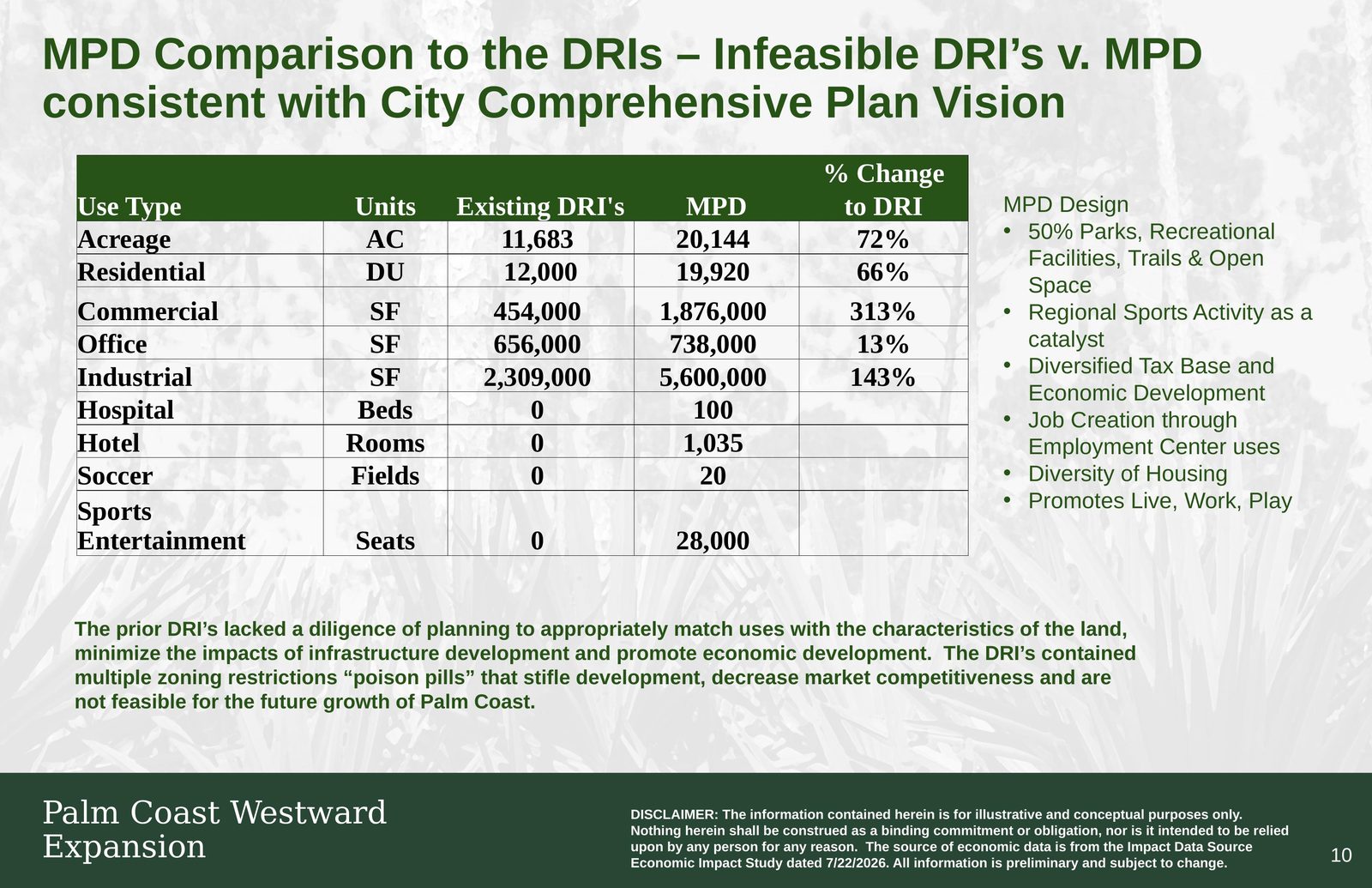
Underneath, the applicant explains itself — their language, on their own slide:
“contained multiple zoning restrictions ‘poison pills’ that stifle development, decrease market competitiveness and are not feasible for the future growth of Palm Coast.”
Slide 10, describing the two 2010 DRIs — the presentation the applicant intended to deliver, August 4, 2026Poison pills. That’s the word they reached for to describe the workforce housing requirement, the groundwater protections, the water-quality monitoring, the concurrency rule that put infrastructure ahead of rooftops. This outlet has already documented that every one of those pieces got left behind in the move from DRI to MPD. What we didn’t have, until now, was the applicant calling that the point — not a side effect of the redraft, a restriction they meant to remove.
A $6.5 million bill Palm Coast already signed for
Eleven slides later, the deck gets to the loop road — and a number that belongs to Palm Coast right now, whether this MPD gets a second reading in October or not.
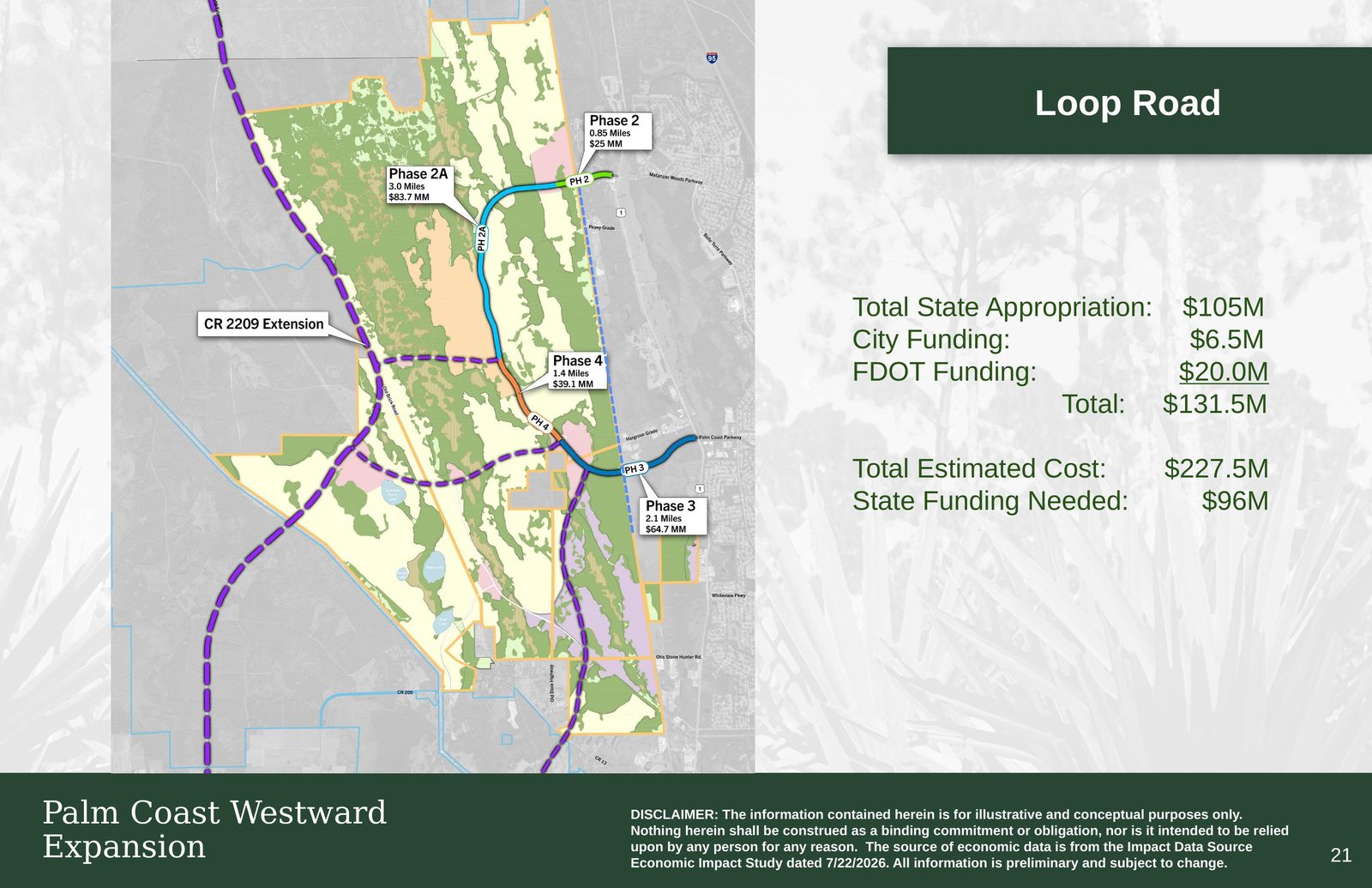
State appropriation: $105 million. FDOT: $20 million. City: $6.5 million. That’s $131.5 million secured against a total estimated cost of $227.5 million — leaving $96 million in state funding the deck says still has to come from somewhere.
The $96 million gap is the applicant’s ask. The $6.5 million isn’t — that’s Palm Coast’s money, already committed, a contractual commitment the city carries into this deal today.
Three fiscal-benefit numbers, and none of them match
Charles Pennyfeather already took apart the $2.4 billion fiscal-benefit study this deal rests on. Its headline numbers: $756.7 million net benefit to the City, $1,135.6 million to the County, $434.4 million to the school district.
Slide 29 — the last content slide before the deck asks Council for three votes — puts different numbers in front of the room: $667 million to the City, $976 million to the County, $385 million to the School District.
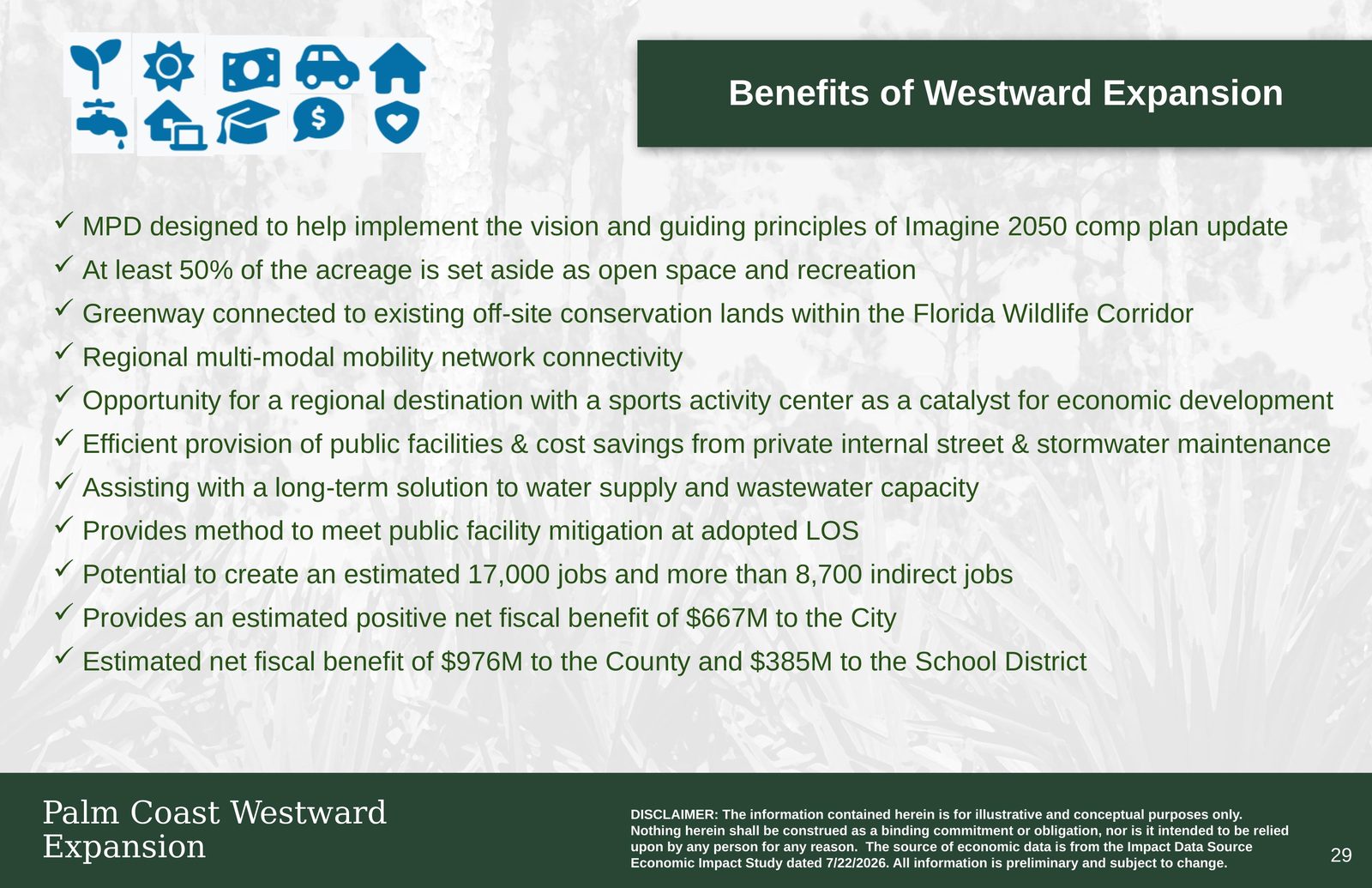
None of the three match the study’s net benefit, present-value, or benefit-to-cost lines. The closest thing to a match anywhere in this exercise is the County’s $976 million, which lands near a different number entirely — the study’s $975.5 million subtotal for the cost of county services. Not a benefit. A cost. Coincidence or source, we don’t know. We’re telling you where the numbers don’t line up. That’s as far as this one goes.
The school district doesn’t get one number. It gets three. Slide 13 puts $466 million in school facility costs against $361 million net benefit. Slide 29 says $385 million. The underlying study says $434.4 million. Three numbers, two from the same deck, none agreeing with each other or with the study the whole presentation is built on.
The water, in their own words
Slide 22, titled Water Supply, has exactly two lines: “Coordinating with the Utility Department on a new Wellfield Exploration Area.” “Exploring site for new utility plant.” Coordinating. Exploring. Not secured, not permitted, not built.
What happens next
None of this reached Council on August 4 either. Six hours in, Council tabled the two votes that actually decide this — the FLUM amendment and the MPD itself — to a special meeting on August 25. The annexations went through on a contingent first reading. The rest didn’t.
Council signaled it will move forward. Not as written. More non-residential acreage. A cap on density. Old Brick Road preserved, the county at the table on it. Whether “poison pills” survives round two is the applicant’s call to make. Council finds out August 25 whether pulling them was worth it.
The presentation the applicant intended to deliver at the August 4, 2026 City Council meeting, all 31 slides as originally designed. Slide 10: DRI-to-MPD comparison table and “poison pills” language. Slide 13: school facility costs and net benefit. Slide 21: Loop Road funding breakdown. Slide 22: Water Supply. Slide 23: Annexation acreage. Slide 29: fiscal benefit summary. Slide 30: October 6, 2026 final adoption hearing.
The study underlying the deck’s fiscal-benefit claims. Net benefit figures per Table 17 (p.21) and Tables 18–20 (pp.22, 25, 28): $756.7M City, $1,135.6M County, $434.4M School District. See also this outlet’s full analysis of the study’s methodology.