Palm Coast Still Publishes DC Blox at 100,000 Square Feet
In June, the city called 100,000 square feet inaccurate. The document that says it is still posted on the city’s own server. And the bigger question — who got to decide any of this — was never put to the people we elect.
We stayed off this one.
It’s been covered to death.
But on one of our routine surveillance rounds of the public record, we found this. The city is saying two things at once. In June, the city called the project’s size — a hundred thousand square feet, two buildings — inaccurate, and said it didn’t reflect the project. But the city had published a document saying exactly that — and as of this writing, it was still posted on the city’s own website. The same government that called the number false was still handing it out.
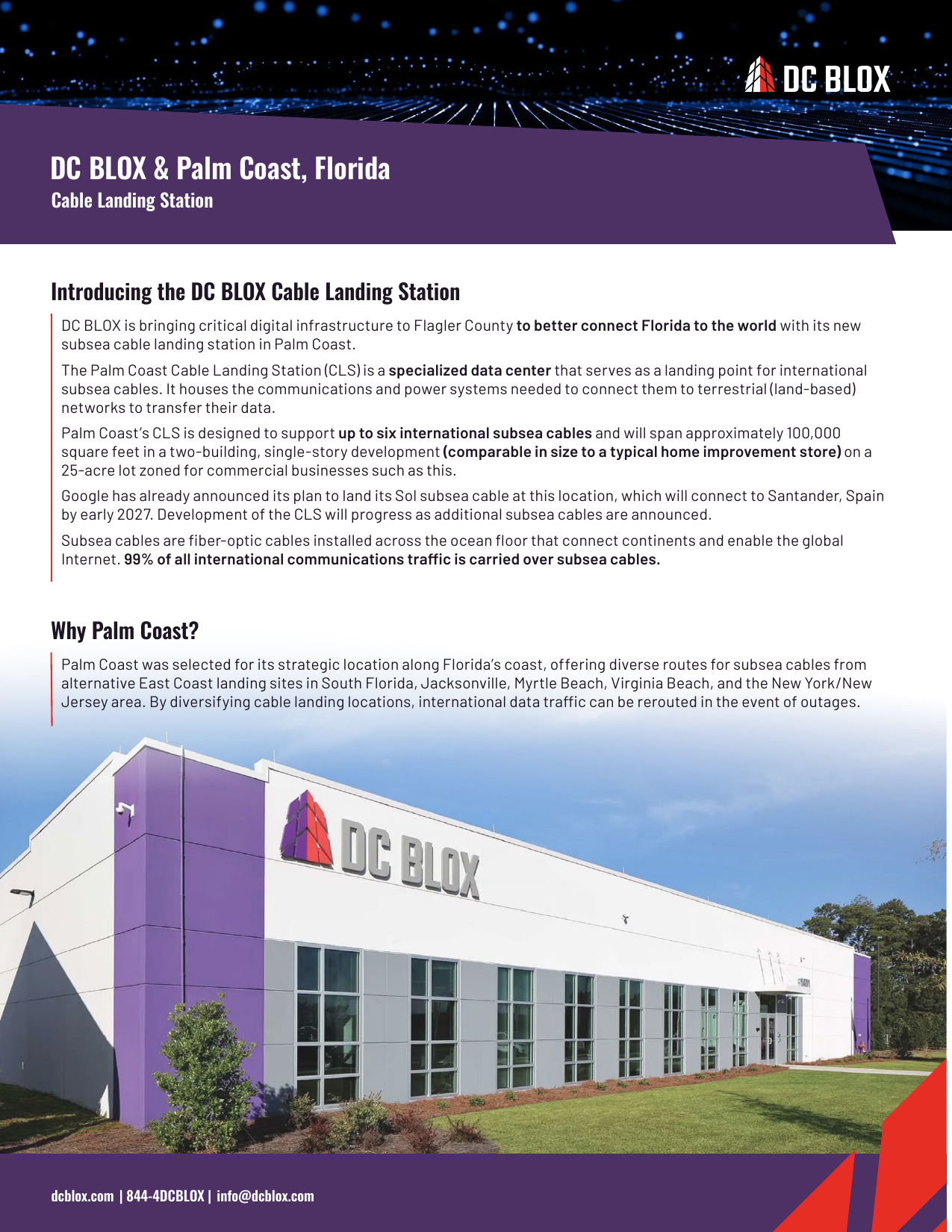
That’s what pulled us in. Not the noise — the contradiction. And it points at something bigger than one building: a town that handed what is arguably the biggest decision in its history to the handful of people who never have to face a voter for it.
Start with the planner who handled it. A man like that studies for years how to build a city — how to make it walkable, how to fit more people onto less land and have it still work. It’s a craft. But school never teaches you how to leave a thing alone. The whole education points one way: build. So when Google’s people hand him the most polished application he’s seen in years, he doesn’t see a problem. He sees beautiful work, and he admires it. That’s what his training taught him to do.
Here’s what nags. Before any of it was approved, a city planner looked at the plans and asked Google’s people for one thing: spell out the equipment yard. In detail. And he told them why it mattered — that yard was the difference between a public hearing and a signature at the counter.
Why would he say that? A set of plans like this doesn’t come in vague. These weren’t sketches on a napkin. Google’s engineers don’t leave a number fuzzy or a line half-drawn. It’s not a smudge on the page he’s asking about. The design either fits under the rules or it doesn’t.
It sounds like a waitress leaning in to tell you the soup and half-sandwich rings up cheaper if you order it as the daily special. Helpful. Friendly. Nothing wrong with it at the counter of a diner. But the thing the discount buys here isn’t a couple of dollars. It’s your seat at the table.
And here’s the thing — he probably wasn’t being sly at all. He thinks differently than we do. To a man who has spent his life inside the code, that forty-thousand-foot line isn’t the public’s seat. It’s a routing rule. It’s Tuesday. He’s sorted a hundred projects by it and never once thought of it as the moment a town does or doesn’t get to speak. So he pointed at it the way he’d point at a setback or a drainage note. No malice in it. Which is exactly the problem. We made a man who sorts buildings the last guard at the door where the public walks in.
Here’s what’s on the record: a city employee pointed straight at the one number that decides whether you get a say, and not long after, that number came in just under the line.
The office that brought Google in is economic development, and you should understand what that call meant to them. Their whole job is to land the new company — the big name, the win. And Google is the biggest catch that office has had in years. Imagine it. The most famous company on earth wants to come to your town and sit down with you. You’d be thrilled. Any of us would. So they did what that office does. They sold it, hard, as the catch of a lifetime.
And that document we opened with — the hundred thousand, the two buildings — that’s the sale. The city posted it on its own website, put its name on it, and handed it to residents as fact. As of this writing, it was still there. Then June came, and the city stood up and called that same number wrong. Here’s what nags: with the whole town on fire, the city swearing the number was false, you’d think someone would walk down the hall and say, maybe we should take that down.
They were just doing what they were trained to do. The planner planned. The economic office sold. Run true to type, both of them. But if everyone was doing their job, then who wasn’t?
The ones we elect.
The planner’s focus is the building. The economic office’s focus is the company. But the people we put on that dais — their focus is supposed to be us. The community. The people who live here and have to wake up next to whatever gets waved through. That is the entire reason the seat exists. And it is the one focus this decision never had.
And this was no ordinary thing to wave through. A cable landing station is where the world’s data climbs out of the ocean and comes ashore — onto our beach, into our town center. Washington treats it as a matter of national security. The Justice Department told the FCC to stand down. The Defense Department was copied on the letter. As of this writing, the license sat frozen while the federal government decided whether Google must accept security conditions before a single cable is allowed to land. That is a question about this community’s safety — exactly the kind of question we elect people to weigh. And it was never weighed at all.
So how does a project this important skip the people elected to make it?
Administrative review. A rule that allows staff to make decisions that should be made by those we elect.
And here’s the part worth holding onto: it can be ended. Administrative review wasn’t handed down from on high. Tallahassee didn’t impose it. Washington didn’t write it. It is a local rule, put in the local code by a local ordinance — by a vote, on some forgotten night, by people who sat on that very dais. A vote put it in. A vote can take it out.
End it.