An Asphalt Factory: Use Not Permitted
At the end of Hargrove Grade, where the industrial park runs out of road, there is a six-acre lot with a rail spur beside it and a construction company’s yard on it. The owner has applied to put an asphalt plant there.
Palm Coast’s Land Development Code keeps a in the city. Asphalt manufacturing plants are on it, with hog farms, oil refineries and deep well injection of waste.
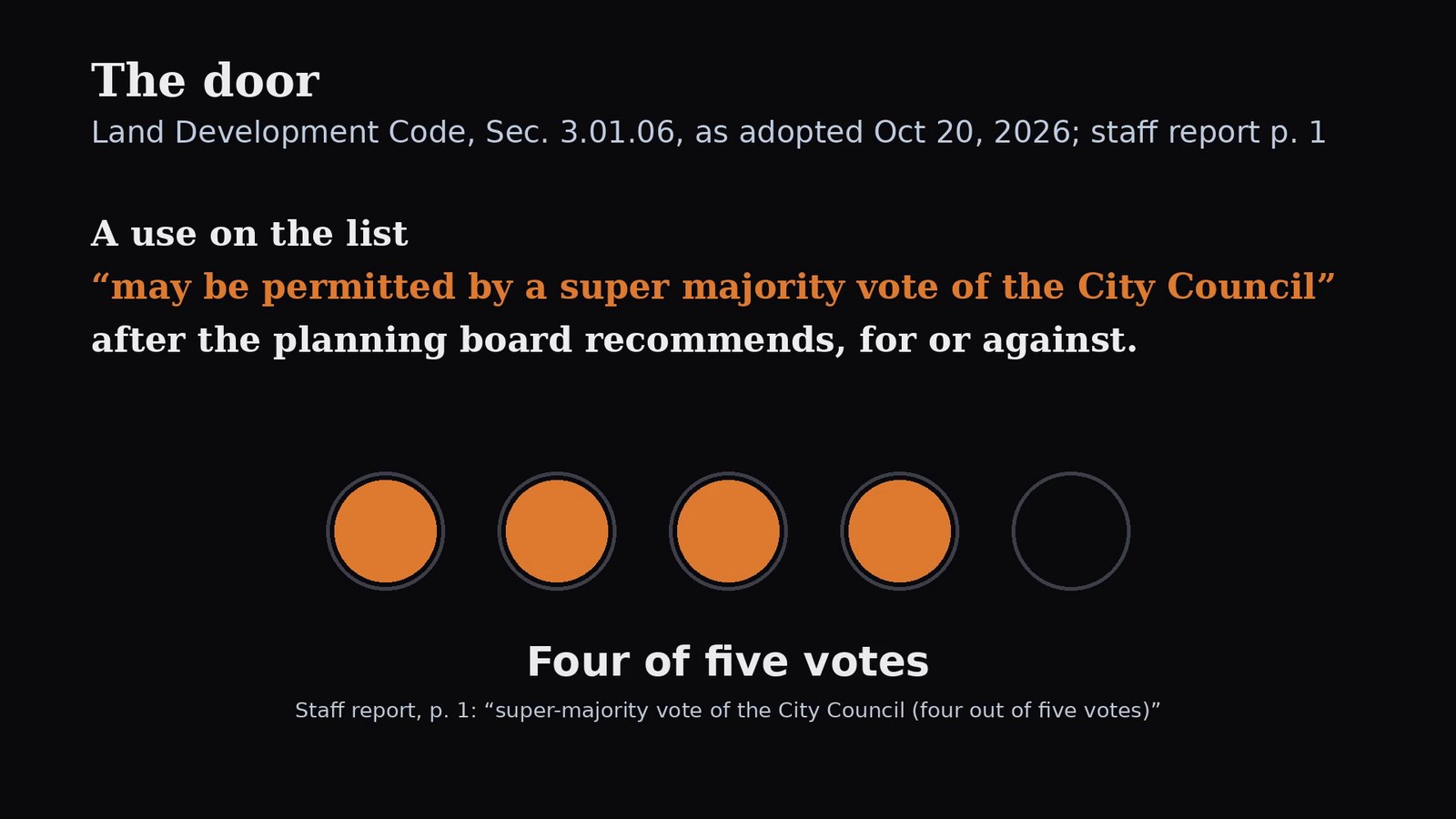
The same section leaves a door open. A use on the list may be permitted by a super majority vote of the City Council, after the planning board makes a recommendation. That is four votes out of five.
Staff says this appears to be the first application anyone has made under that section.
What they ask for
The owner is ACCI Ventures. It bought the property in June of 2023 and uses it for heavy construction and excavation. The land is zoned heavy industrial and the future land use is industrial, and neither would change.
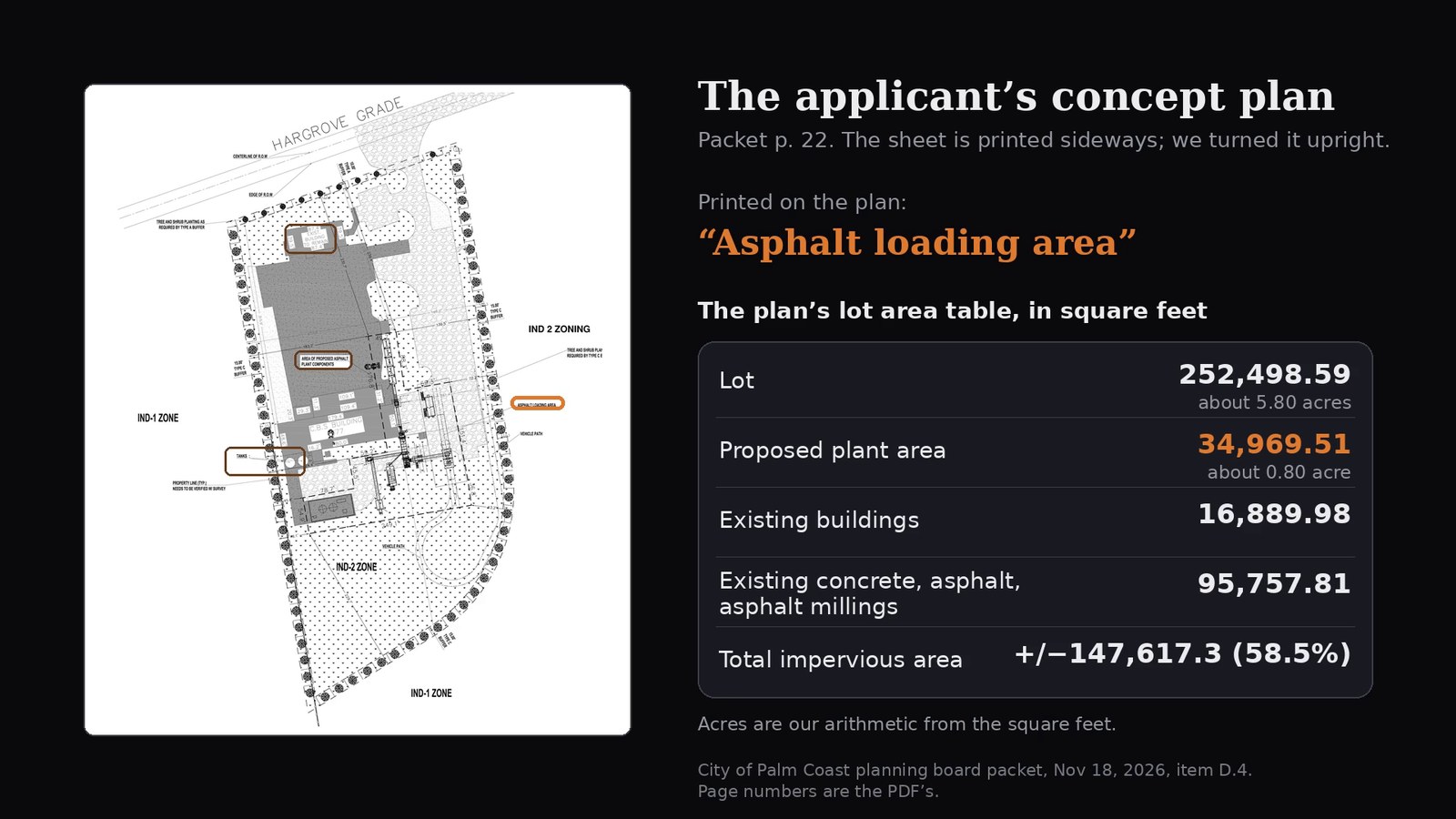
The applicant’s attorney describes an asphalt plant in general terms: aggregate and sand feed systems, conveyors, a drying and mixing drum, asphalt cement storage, emissions control, silos and a loading area.
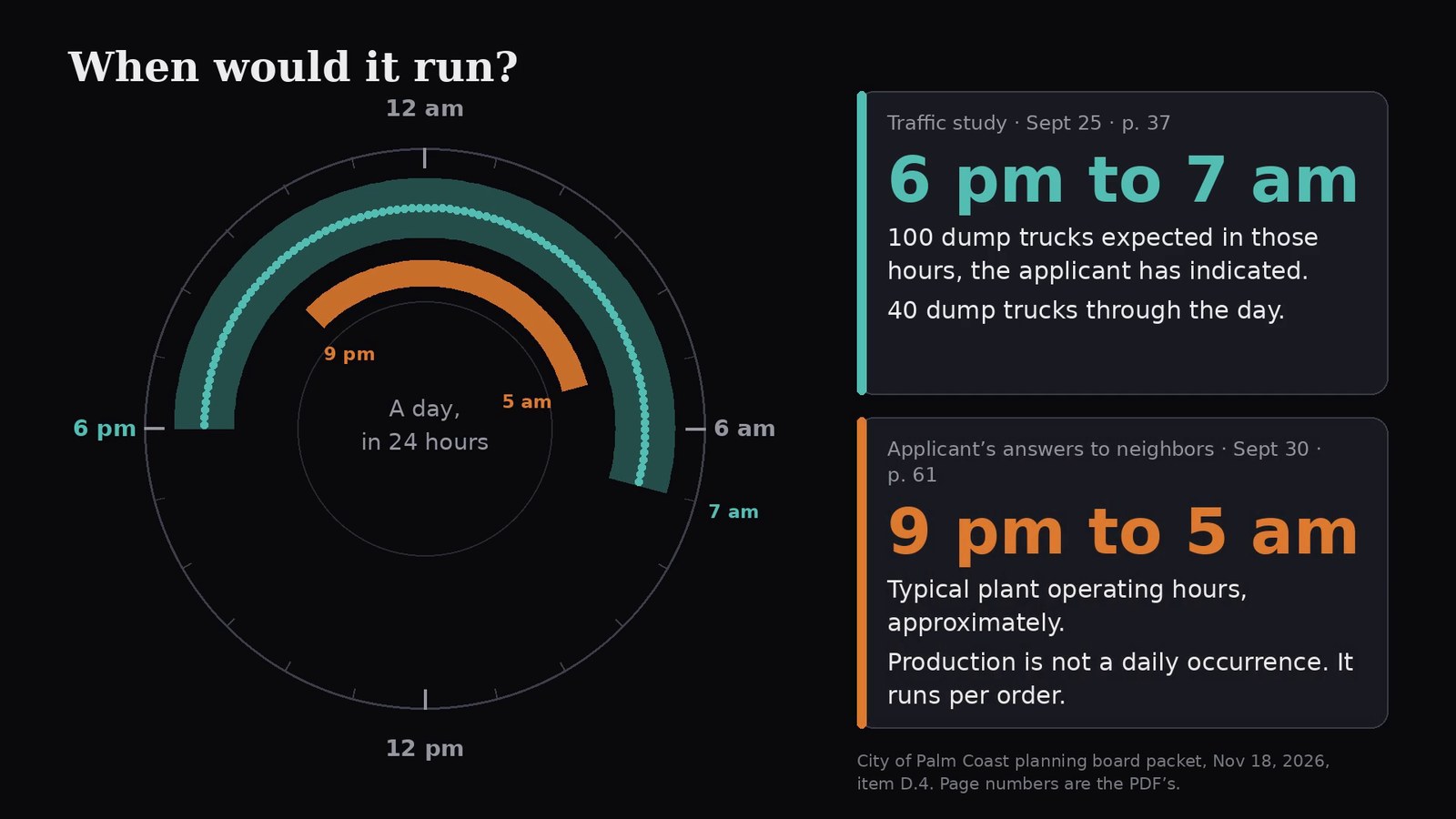
The packet says how it would run. Production would happen at night, roughly nine in the evening to five in the morning, and not every day. A batch is made to order, then the plant shuts down, and output is expected to run 250 to 300 tons on a typical day, which the applicant puts at 10 to 15 truckloads.
The first year starts near 50,000 tons, about 2,000 to 2,500 truckloads. The plan is to grow to between 200,000 and 300,000 tons a year, depending on growth, which is 8,000 to 15,000 truckloads a year.
A plant making 300 tons a day, every day of the year, would reach about 110,000 tons, or 4,400 to 5,500 loads. The packet does not say how a year gets from there to 200,000 or more.
The truck counts are our arithmetic. The applicant’s figures say 10 to 15 truckloads a day for 250 to 300 tons, which works out to about 20 to 25 tons a load. They count only asphalt going out, not the stone and sand coming in, or the employees.
The numbers that don’t match
The packet is more than sixty pages, from the applicant, the applicant’s engineers and the City. On several basics, it gives more than one answer.
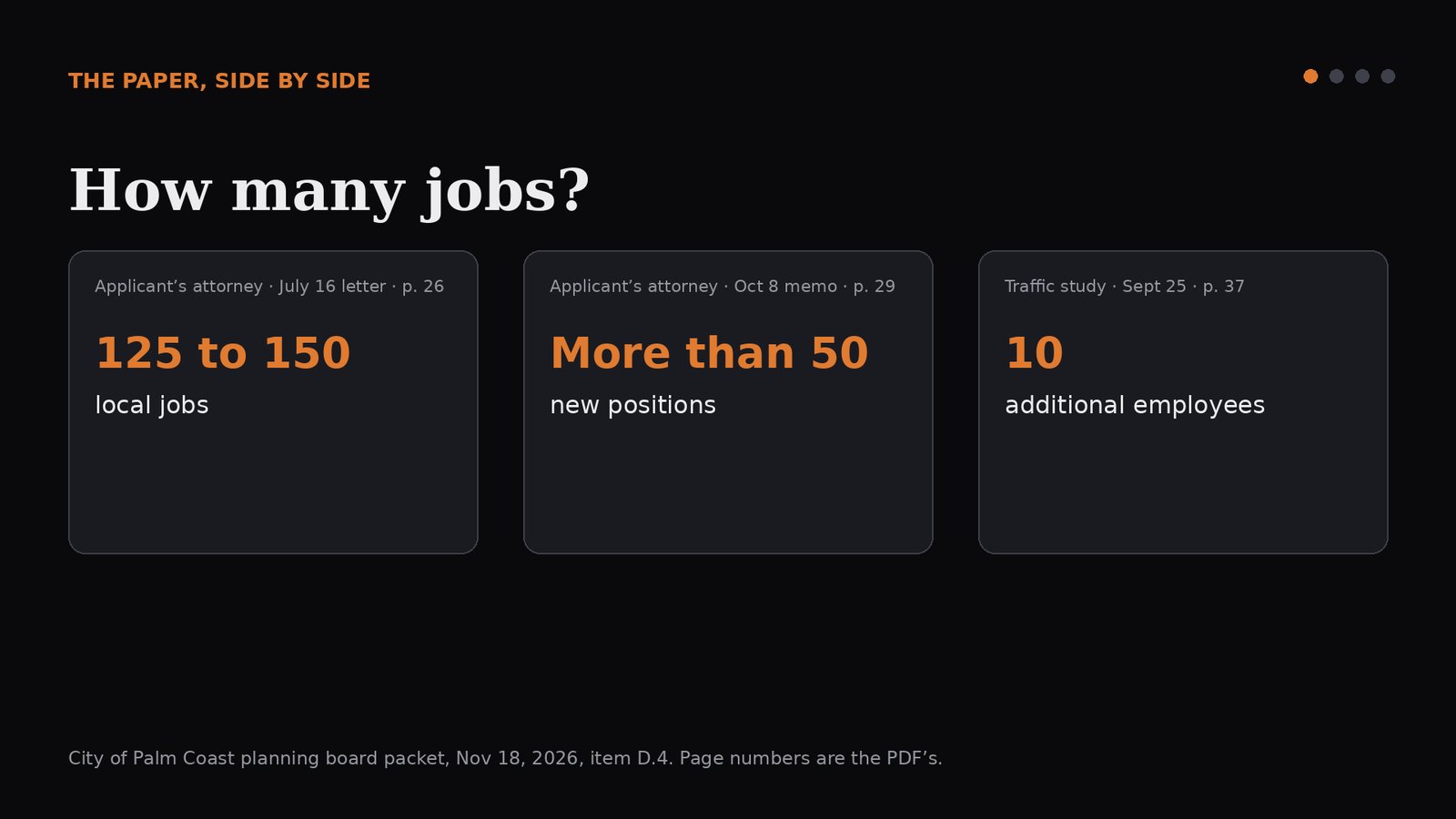
Jobs. The applicant’s attorney says the plant would create 125 to 150 local jobs. A later memo from the same attorney says more than fifty new positions. The traffic study counts ten additional employees.
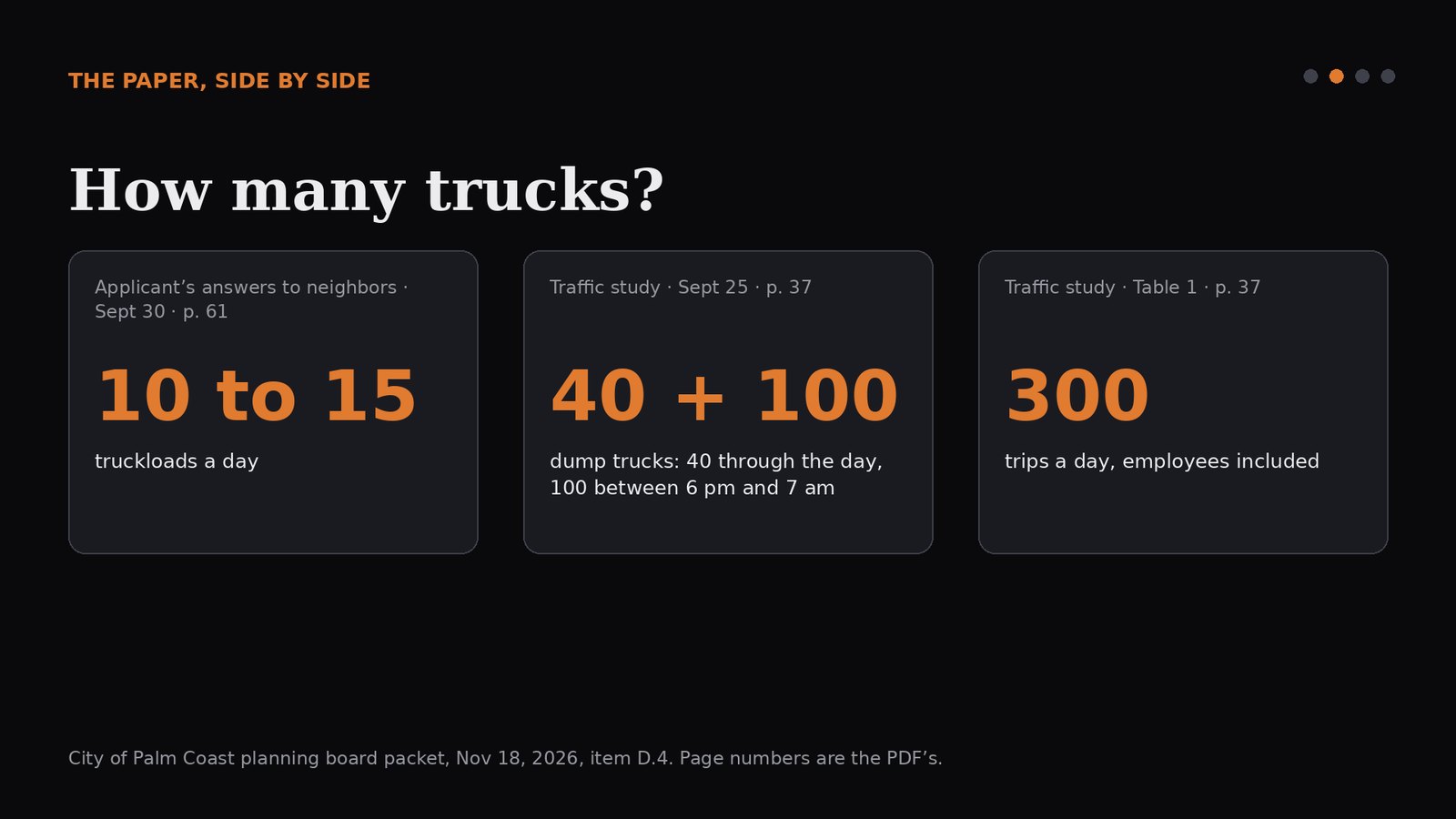
Trucks. The applicant’s answers to neighbors say ten to fifteen truckloads a day. The traffic study counts forty dump trucks through the day and a hundred more between six at night and seven in the morning, about three hundred trips in all, counting employees.
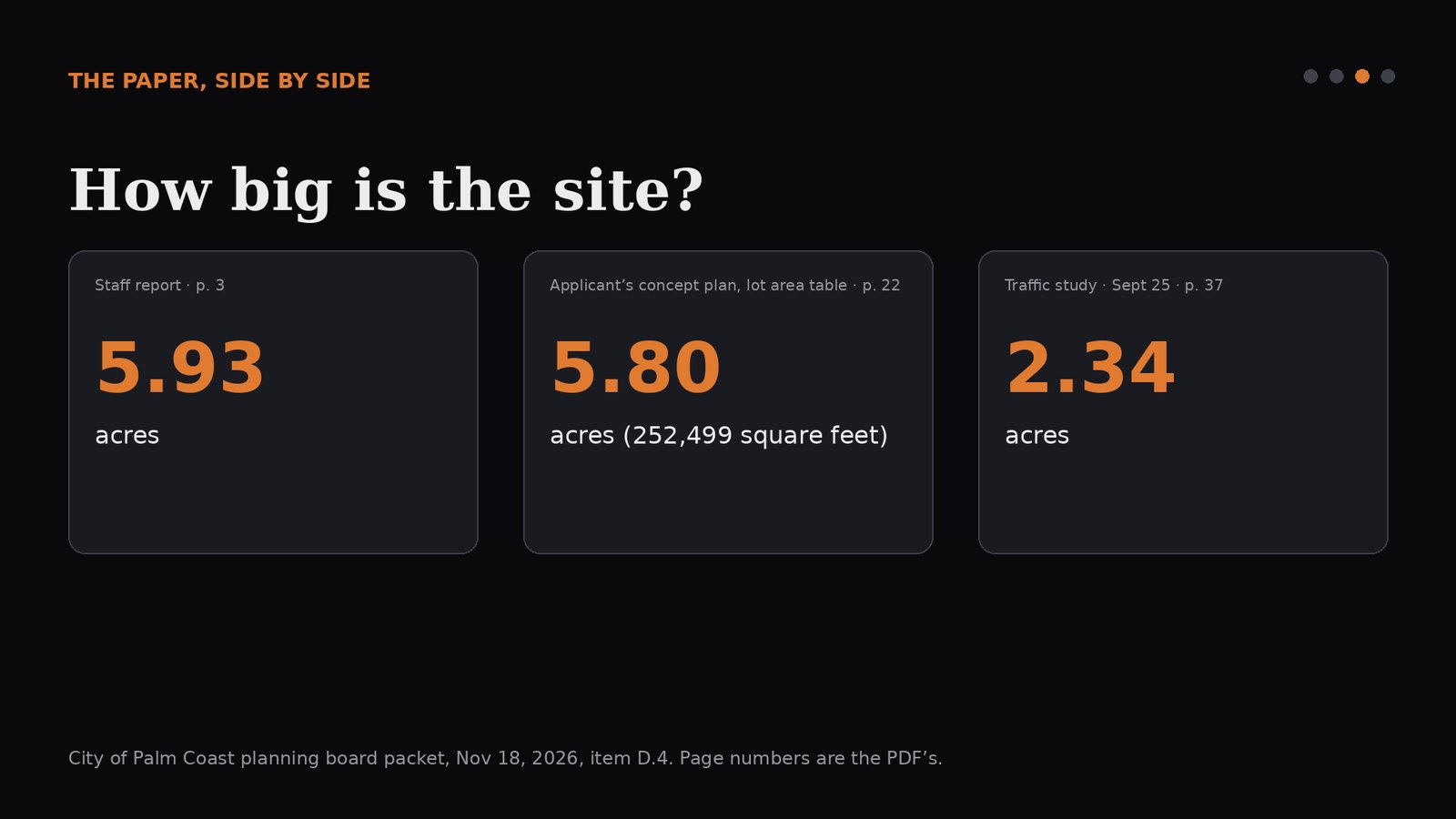
Acres. The staff report says five and ninety-three hundredths. The concept plan’s table says five and eight-tenths. The traffic study describes a 2.34-acre site.
The nearest plant. The applicant’s attorney says the nearest existing asphalt plant is nearly thirty miles away. The traffic study calls this an expansion of an existing asphalt plant to the south.
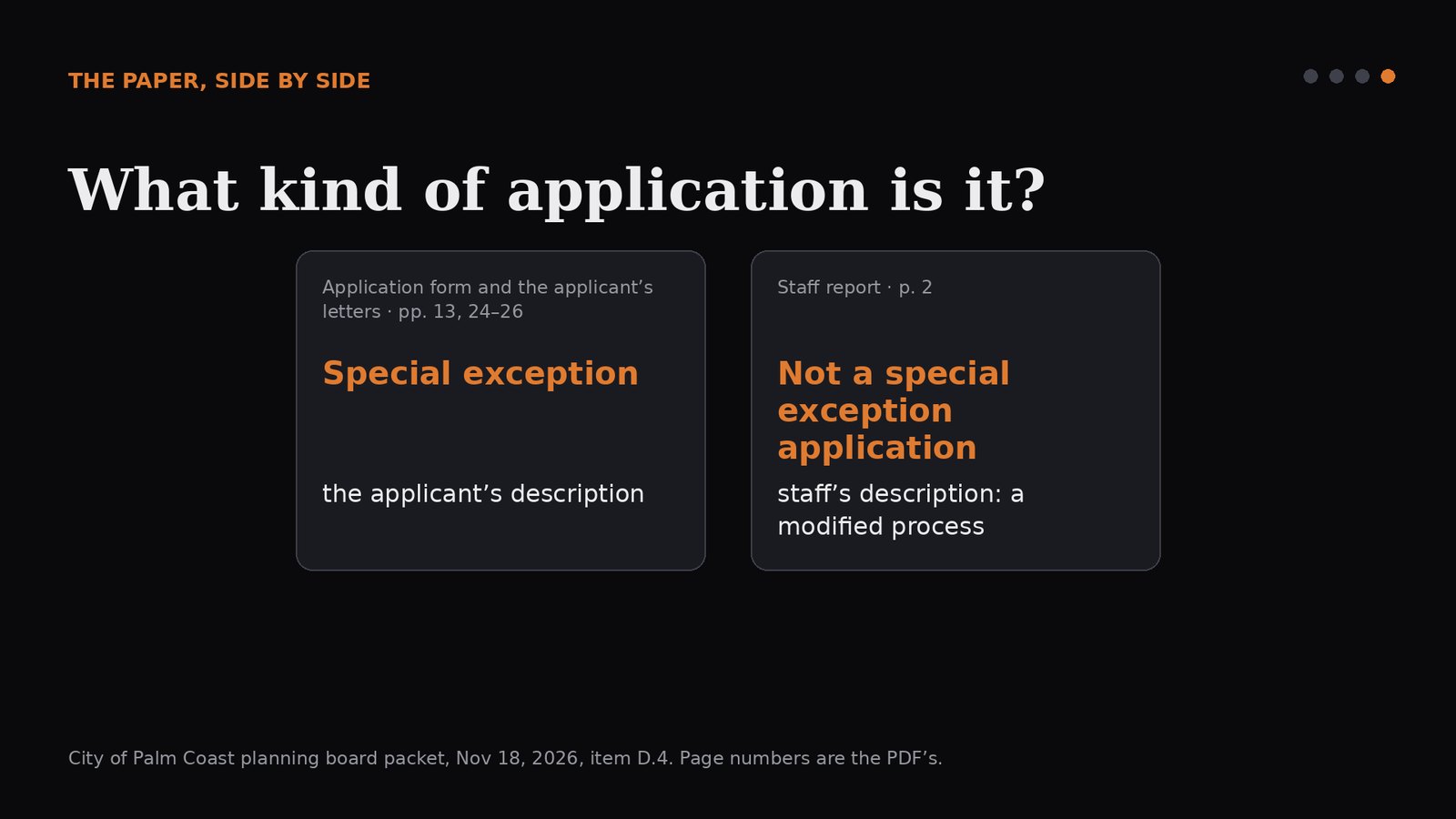
And the process. The application, the applicant’s letters and the survey affidavit call this a special exception. Staff’s report says it is not one.
None of this has to mean anything is wrong. What it does mean is that the planning board will be asked to recommend on a record that doesn’t agree with itself.
What staff says, and doesn’t
Staff’s report walks through five findings the Code requires. On the first, whether the plant is contrary to the public interest, staff writes that it may be, because the Code lists the use as not permitted. Staff adds that if the plant is approved, a technical site plan would follow, and that outside agencies, including the state’s environmental agency, would review parts of it.
On a different point, staff writes that the lot sits at the end of an industrial park, beside a railroad, in heavy industrial zoning, and calls it, in staff’s opinion, the most likely place in the city for this kind of use. On the closest homes, staff says the nearest residential zoning is a tract in Palm Coast Park to the north, and that the tract has a fair amount of wetlands.
What staff does not say is whether the board should approve. The report says staff was instructed not to give a recommendation, by the Interim Community Development Director, after a discussion with the City Attorney.
The applicant’s attorney had asked for one. His memo to staff says the board and Council will rely on the City’s technical review and requests a recommendation, with the reasons for any criterion staff finds unmet.
Staff also says about an acre and a quarter on the south side of the lot was cleared without a permit, seen on aerial photos, and that the site would have to be restored. The applicant’s letter calls the request mainly an addition of equipment, without substantial alteration of the land.
The City’s public permit search lists , from 2006 to June of 2016. The owners named on them are earlier companies. Not one names the current owner or American Civil Construction.
They cover a silo demolition, a chemical blending company, added laboratory space, a trucking company’s dispatch office and truck repair shop, and a loading dock with a retaining wall. The search shows no permit that mentions recycling, land clearing or storing materials. It covers building permits only, so Palm Coast Storylines has asked the City for the rest of its records on the lot.
What the vote decides
A yes from the planning board is a recommendation, not a permit. If Council approves, the result is a development order that lasts twelve months, with one twelve-month extension. It does not authorize site work.
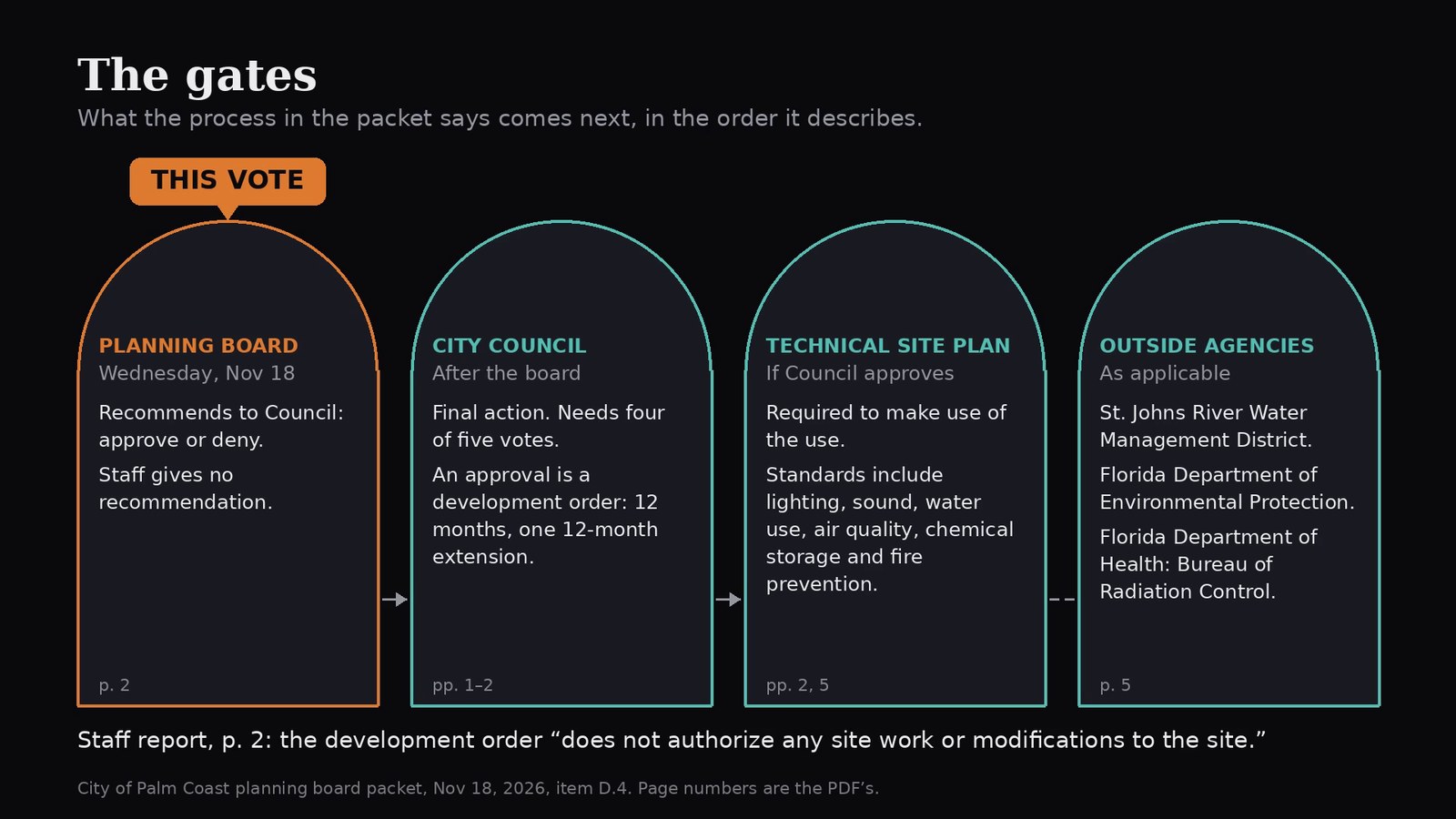
To build, the owner would have to file a technical site plan, and that is where lighting, sound, water use, air quality and chemical storage are reviewed. Staff names three outside agencies: the water management district, the state environmental agency and the health department.
Florida has a that a plant can register under. The rule sets a ceiling of 600,000 tons a year for the kind of plant described here, a limit on dust and smoke, and a stack test. It says nothing about distance from homes, and a separate state rule against objectionable odor applies to any source. Whether this plant would use the general permit is not in the packet.
Who has spoken before, and who decides
The owner of 77 Hargrove Grade has spoken to this board before. In February, in public comment at the board’s hearing on a concrete plant at 56 Hargrove Grade, he asked the board to approve it. He said he buys that company’s concrete in other cities. That request .
He said his dump trucks and tractor-trailers use Hargrove Grade every day with no issues, and that he did not know what residents on the road were experiencing from his trucks. He said Palm Coast is growing west, and that more industrial land west of the railroad will connect to Hargrove Grade. And he said that in 35 years in the business, he has found concrete companies, asphalt plants and steel manufacturers to be community partners.
What the packet does not contain
At the September 29 neighborhood meeting, attendees asked about air emissions and odor. The applicant’s attorney recorded the applicant’s answers in a letter to the City the next day. It says the plant uses a drum-mix process with a baghouse filter, and natural gas to heat and dry the aggregate.
It acknowledged that asphalt production has an odor. It said the plant would need a mass-emissions permit and would have to meet federal, state and local permitting requirements, that daily production would run only three to four hours, and that its volatile organic compound emissions are relatively low. It also said the U.S. Environmental Protection Agency generally considers modern asphalt plants low risk.
Here is what the packet does not contain. An air permit application. The size of any equipment, or the height of a stack. Any measurement of odor, noise or dust.
The distance from the lot to the nearest school, or the nearest city wellfield. The City’s Comprehensive Plan says an industrial use’s closeness to wellfields shall be considered. The packet doesn’t say how close.
It also leaves out the distance to the nearest home. Palm Coast Storylines to find out. The nearest home is a little over a mile east of the lot. Within two miles there are more than 1,700 residential properties.
What other studies say about is at the bottom of this story, with links to the reports.
Both sides, at their strongest
The applicant’s strongest point: the lot is already zoned for heavy industry, sits at the end of an industrial park beside a rail line, and staff itself calls it the most likely place in the city for this use.
The other side’s strongest point: the Code lists the use as one that can create nuisances and adverse effects on neighboring land, staff finds it may be contrary to the public interest, and the packet does not give the distance to a home, a school or a wellfield.
The board votes Wednesday. The Council decides later, and it needs four.
The packet: Planning and Land Development Regulation Board, Nov. 18, 2026, item D.4, AR 6785 (PDF)
Thank you for taking the time to read, listen to or watch our stuff.
— Johnny Diamond · Palm Coast Storylines